
📋 Table of Contents
According to the Environmental Protection Agency (EPA), biocidal antifouling coatings are under increasing scrutiny, making a proactive underwater coating health check essential for every responsible owner at Richmond Riviera Yacht Harbor. Waiting for your boat to feel sluggish or vibrate is a $10,000 gamble that often results in premature haul-outs and avoidable blister repairs.
As of 2025, the unique microclimate of the Potrero Reach creates a high-fouling environment where freshwater runoff meets San Francisco Bay salinity. This specific chemical cocktail accelerates the degradation of traditional ablative paints. Here is how we help Bay Area boat owners transition from reactive scrubbing to strategic coating management.
Step 1: The Biofilm and Slime Adhesion Test
The first sign of coating failure isn’t a barnacle; it’s the specific way slime clings to your hull in the brackish waters of the East Bay.
What most people miss is that not all slime is created equal. In the Richmond Riviera Yacht Harbor, we often see a thick, brown ‘primary slime’ that forms within days of a cleaning. The underwater coating health check begins by testing the ease of removal. If a light wipe with a microfiber cloth doesn’t reveal the true color of your paint, your biocides are no longer leaching effectively.
- Level 1 (Healthy): Slime wipes away with zero pressure.
- Level 2 (Warning): Slime requires a firm thumb-wipe to clear.
- Level 3 (Failure): Slime has hardened into a ‘grass’ or ‘fuzz’ that resists soft tools.
Step 2: Bottom Paint Evaluation for Ablative Thinness
Visible ‘ghosting’ or seeing the primer layer is an immediate signal that your bottom paint evaluation has moved into the red zone.
Ablative paints are designed to wear away, but they don’t do so evenly. High-flow areas like the bow, rudder, and leading edges of the keel typically fail first. During a professional underwater coating health check, we look for ‘color-through,’ where the underlying epoxy barrier coat or previous paint color begins to peek through the current layer.
The real kicker? Once you see the primer, you’ve lost your chemical protection. You aren’t just fighting growth; you’re allowing the fiberglass to absorb water, which leads to osmotic blistering. This is especially critical for recreational boat owners who value long-term hull integrity over short-term savings. For a detailed look at how we document these stages, visit our Hull Cleaning Guides.
Step 3: Evaluating Foul-Release Coating Integrity
The transition to non-biocidal, silicone-based coatings requires a completely different antifouling health check methodology.
Here’s the thing: while traditional paints use toxins to kill growth, foul-release coatings use a ‘slick’ surface to prevent it from sticking. In the Richmond Riviera, the high current can actually help these coatings stay clean, but only if the surface remains perfectly smooth. We check for ‘micro-tears’ or lifting edges that can occur during aggressive dock-side maneuvers.
- Inspect for ‘orange peel’ texture which indicates coating detachment.
- Check for mechanical damage from floating debris common in the North Bay.
- Verify that the ‘slick’ feel is present across the entire waterline.
Need a professional eye on your silicone coating? Schedule your free estimate today for a detailed photo-verified inspection.

Step 4: Running Gear and Zinc Anode Depletion
Your underwater coating health check is incomplete without a rigorous assessment of the running gear and galvanic protection.
In our work with high-end yacht owners at Richmond Riviera Yacht Harbor, we’ve found that stray current in the marina can eat through a fresh set of zincs in under 90 days. We don’t just look at the paint; we measure the remaining mass of your anodes. If your zincs are more than 50% depleted, the electrolysis will start attacking your props and shafts next.
| Component | Healthy State | Failure Indicator |
|---|---|---|
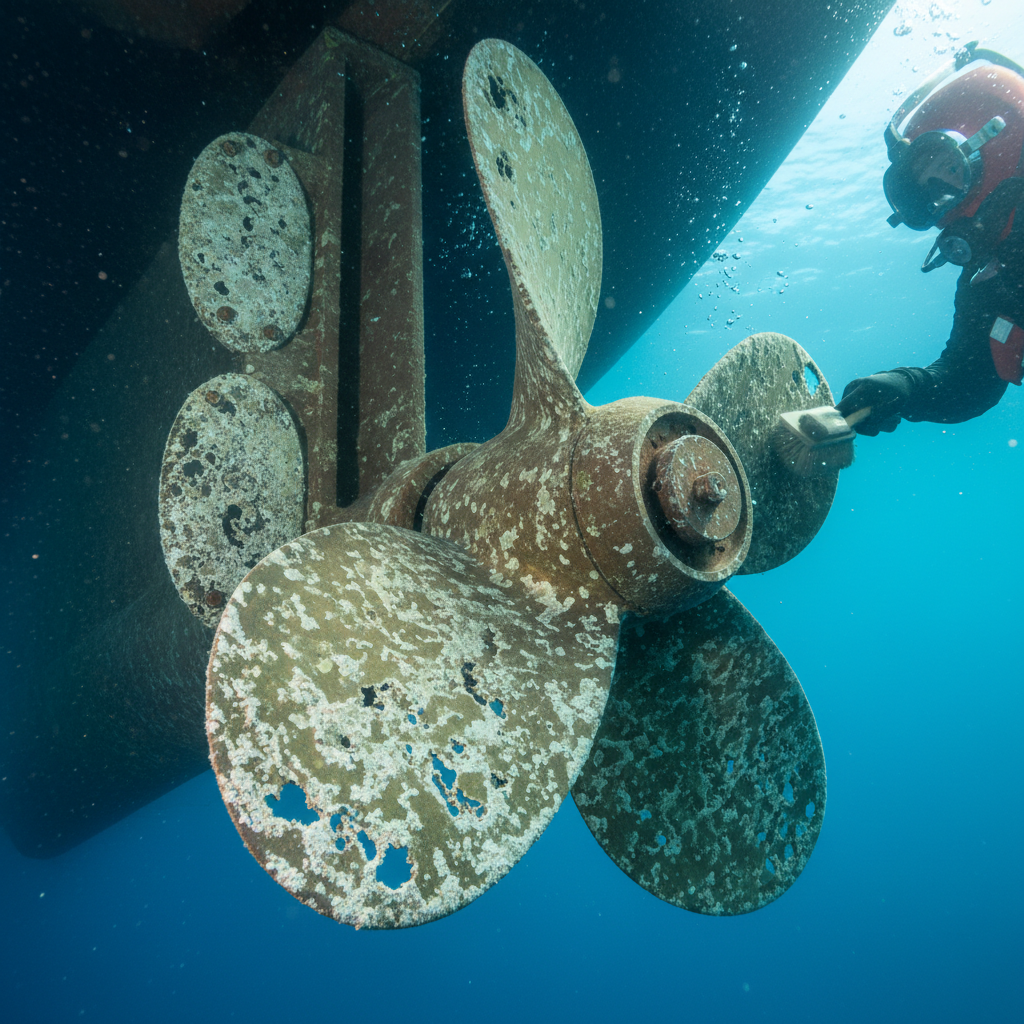
| Propeller | Smooth, polished metal | Pinkish hue or ‘calcium’ crust |
| Zinc Anodes | Solid, slightly pitted | Crumbling, over 50% gone |
| Shaft/Struts | Clean coating/metal | Severe barnacle clusters |
What many miss is that the Richmond current carries high levels of oxygen, which accelerates the oxidation process on exposed metals. Proactive maintenance here is the difference between a smooth cruise and a vibrating mess that ruins your transmission. Check out our Zinc & Corrosion Protection resources for more details.
The Richmond Riviera Microclimate Advantage
Understanding the Potrero Reach current is the secret to extending your boat’s life between haul-outs.
Most boaters assume the whole Bay is the same, but the Richmond Riviera experiences significant freshwater influence from the Delta. This means you deal with different invasive species than a boat moored in Sausalito or Alameda. Our San Francisco Bay hull cleaning specialists use this local knowledge to adjust cleaning frequency based on seasonal runoff patterns.
By using our internal AI content engine, Ingest.blog, we track these environmental shifts to provide real-time advice to our clients. For example, during high-rain winters, the lower salinity in Richmond can actually stun some saltwater-loving barnacles, allowing us to be more gentle with your coating and extend its life by months.
Key Takeaways for Richmond Boat Owners
- Visual Proof: Never accept a diver’s word; insist on before-and-after photos to verify your underwater coating health check.
- Timing: Perform a full bottom paint evaluation every 3 months in the East Bay.
- Compliance: Ensure your service provider follows San Francisco Bay Regional Water Quality regulations for in-water cleaning.
Ready to see exactly what’s happening beneath the surface? Don’t wait for your fuel bill to spike or your speed to drop. Contact 360 Hull Diving for a comprehensive, photo-documented underwater survey at Richmond Riviera. We bring transparency to the depths.
Frequently Asked Questions
How often should I do an underwater coating health check?
In the high-fouling waters of the Richmond Riviera Yacht Harbor, we recommend a professional evaluation every 3 to 4 months. This frequency allows us to catch zinc depletion and early-stage barnacle growth before they compromise the integrity of your hull’s antifouling paint or damage the running gear.
Can I perform a bottom paint evaluation myself?
While you can check the waterline for growth, a true evaluation requires a sub-surface inspection of the keel, rudder, and running gear. Our team provides high-resolution photo proof so you can see the state of your coating without ever getting wet, ensuring total transparency and peace of mind.
Does brackish water affect my antifouling health check?
Yes, the Richmond Riviera’s location near the Delta means the water salinity fluctuates. This can lead to a mix of freshwater and saltwater organisms. A specialized health check identifies these specific growth patterns and allows for a more tailored cleaning approach that preserves your paint’s biocides longer.
What is the difference between a cleaning and a coating health check?
A cleaning is the removal of growth, while a health check is a diagnostic survey. During a health check, we measure paint thickness, evaluate anode life, and look for signs of osmosis or electrolysis. It is a predictive maintenance tool designed to prevent expensive, emergency haul-outs during the peak sailing season.