
📋 Table of Contents
- 1. The Physics of Friction: Why Propeller Fouling Kills Efficiency
- 2. Calculating the Cost: Marine Fuel Efficiency by the Numbers
- 3. The 3-Step Foul-to-Fuel Framework for Running Gear Maintenance
- 4. Strategic Sustainability: Beyond the Bottom Line
- 5. The Performance ROI: Real-World Expectations
- 6. Why Local Context Matters for SF Bay Owners
- 7. Actionable Takeaway: Your Monday Morning Checklist
- FAQs
According to the International Maritime Organization (IMO), even a thin layer of slime can increase a vessel’s fuel consumption by up to 25% due to increased hydrodynamic drag. For commuters navigating the heavy tidal flows between Sausalito and the Embarcadero, propeller fouling isn’t just a maintenance chore—it is a direct tax on your engine’s longevity and your wallet.
Key Takeaways for Bay Area Owners
- Slime is the Enemy: Micro-fouling creates more drag than most owners realize, especially in high-salinity areas like Richmond.
- The 10% Rule: A fouled prop often requires 10% more RPM to maintain the same cruising speed, leading to exponential fuel waste.
- Proactive Grooming: Regular underwater polishing is significantly cheaper than the long-term cost of reactive engine repairs.
1. The Physics of Friction: Why Propeller Fouling Kills Efficiency
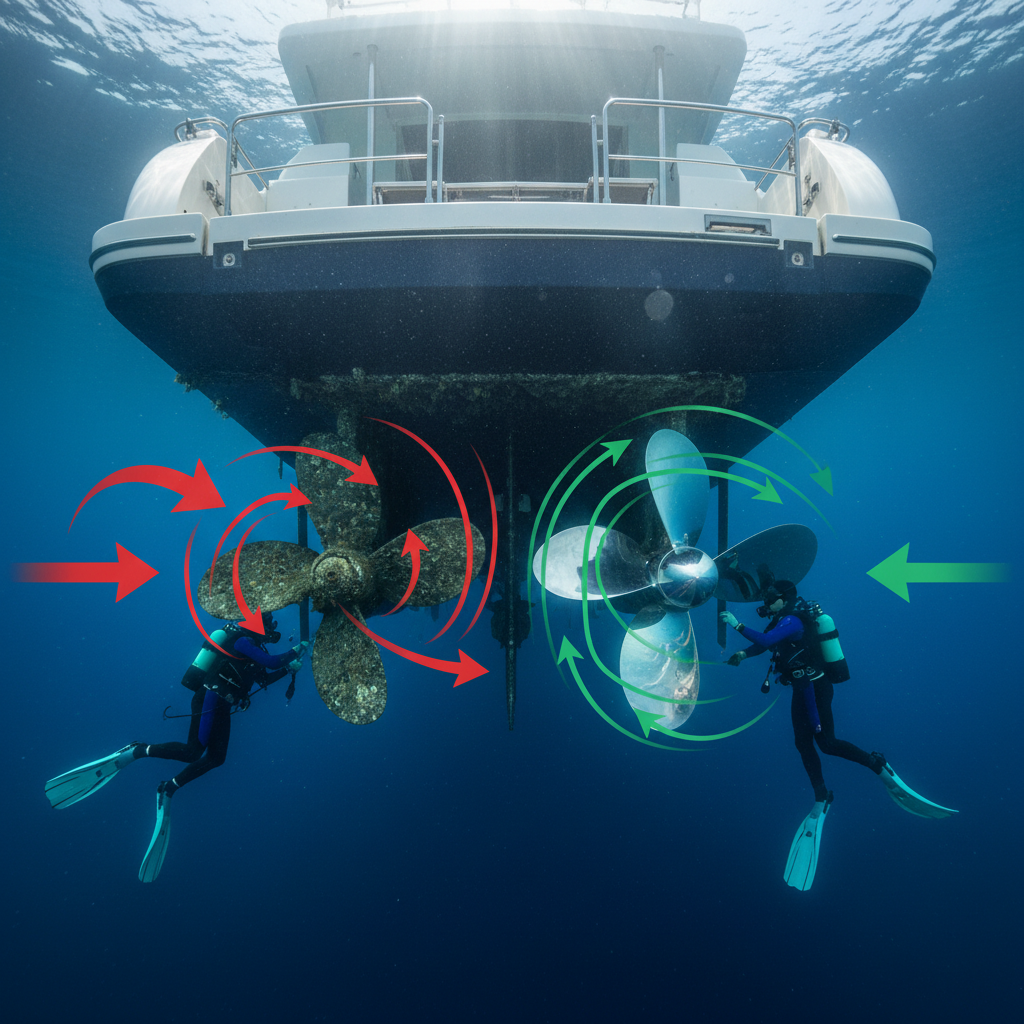
The real kicker is that your propeller is a precision-engineered airfoil; any deviation from its smooth surface disrupts the laminar flow required for thrust. In the San Francisco Bay, where nutrient-rich runoff meets high-velocity currents, biofouling attaches faster than in stagnant freshwater environments.
Most owners wait until they feel a vibration before calling a diver. However, by the time you feel the shudder in the helm at the St. Francis Yacht Club, you’ve likely been overpaying for fuel for months. This “Hidden Tax” of the Golden Gate is amplified by the Bay’s unique hydrology, where currents can reach 5+ knots, forcing a fouled prop to work twice as hard to maintain headway.
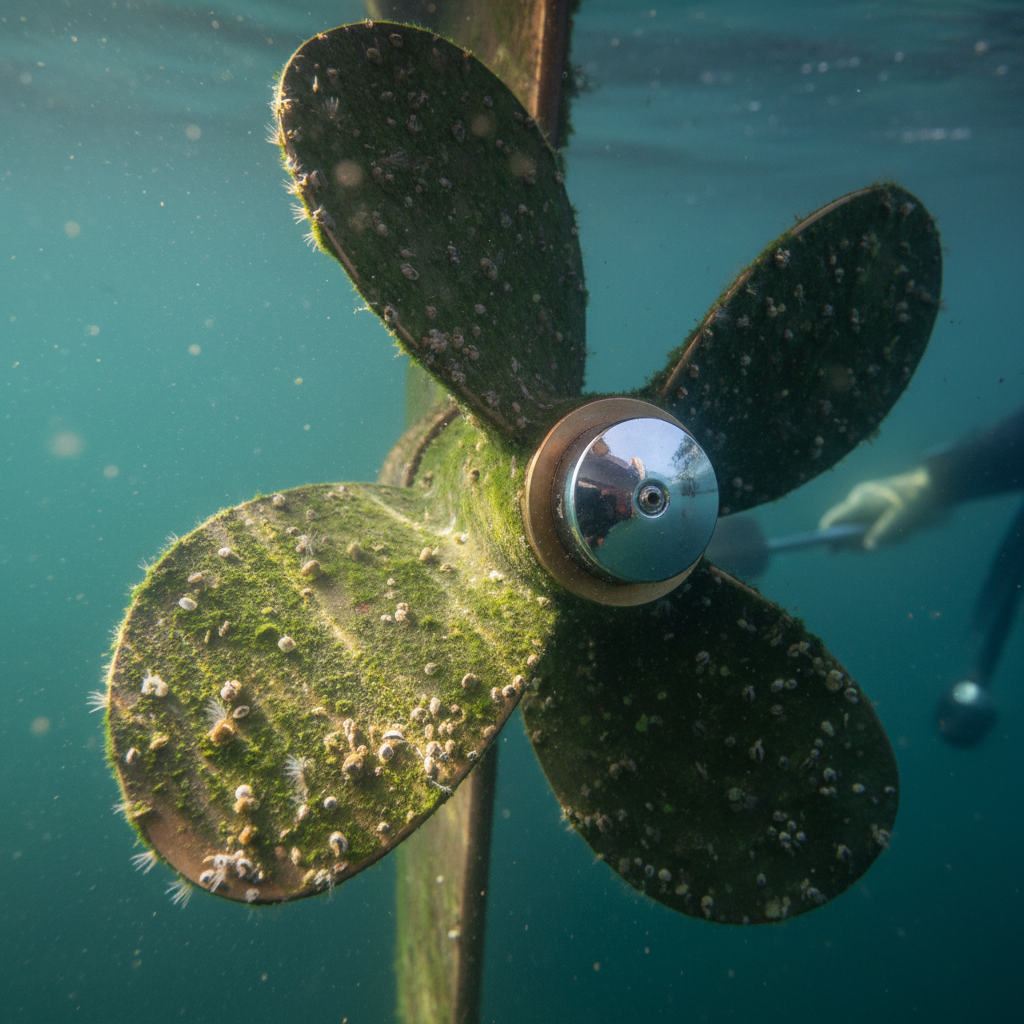
In our work with high-net-worth recreational boaters, we’ve observed that vessels docked at South Beach Harbor often accumulate calcium-based tubeworms faster than those at Berkeley Marina due to subtle differences in water temperature and flow. This localized variation means a “one size fits all” cleaning schedule usually fails.
2. Calculating the Cost: Marine Fuel Efficiency by the Numbers
Marine fuel efficiency is a direct reflection of how cleanly your running gear slices through the water. When a prop is covered in barnacles or heavy biofilm, the engine must increase its torque output to overcome the added resistance, which spikes the exhaust gas temperature (EGT).
| Fouling Level | Estimated Speed Loss | Fuel Consumption Increase | Recommended Action |
|---|---|---|---|
| Light Slime | 0.5 – 1.0 Knots | 3% – 7% | Monthly Grooming |
| Heavy Biofilm | 1.5 – 2.5 Knots | 10% – 15% | Professional Polish |
| Calcareous (Barnacles) | 3.0+ Knots | 20% – 30%+ | Mechanical Scraping |
Here’s the thing: most modern diesel engines are designed to operate within a specific load window. According to Energy.gov, maintaining optimal mechanical efficiency in transport sectors significantly reduces carbon footprints. By ignoring propeller fouling, you aren’t just wasting fuel; you are actively shortening the life of your turbochargers and heat exchangers due to chronic overloading.
Need a baseline for your vessel? Request a professional inspection to see exactly what’s happening below the waterline before your next trip to Angel Island.
3. The 3-Step Foul-to-Fuel Framework for Running Gear Maintenance
To maximize running gear maintenance, you need a repeatable system that moves beyond guesswork. We use a data-driven approach specifically tailored for the aggressive fouling conditions found at marinas like Pier 39 and Treasure Island.
Step 1: The Bio-Assessment & Photo Proof
What most people miss is that you cannot manage what you do not measure. A typical Bay Area mid-market yacht owner should insist on high-definition before-and-after photos. This isn’t just for peace of mind; it’s a diagnostic tool to identify if your zincs are eroding too quickly or if stray current is accelerating growth.
Step 2: Precision Propeller Polishing
Instead of aggressive scraping that can Mar the metal, we utilize specialized polishing pads. This “clean grooming” technique complies with EPA and California State Lands Commission standards by minimizing the release of heavy metals into the water column while restoring a mirror-like finish to your wheels.
Step 3: Zinc & Electrolysis Verification
The final step in the framework ensures your protection is intact. If your sacrificial anodes are depleted, propeller fouling is the least of your worries—electrolysis will begin eating your expensive Nibral props next. We verify the bond between the zinc and the shaft to ensure long-term stability.
4. Strategic Sustainability: Beyond the Bottom Line
Regulatory compliance is becoming a profit center for savvy operators. With the Port of San Francisco moving toward stricter In-water Cleaning and Capture (IWCC) standards, maintaining a clean hull isn’t just about speed—it’s about staying legal. Proactive grooming prevents the establishment of invasive species, which is a key focus of the California State Lands Commission.
But wait—there is a contrarian reality here: more cleaning isn’t always better. If your diver is using overly abrasive tools, they are stripping the protective oxidation layer off your props, making them *more* attractive to barnacles in the long run. The goal is a smooth surface, not a scratched one.
5. The Performance ROI: Real-World Expectations
In our work with local commuters, we frequently see a return to “factory spec” performance after a thorough propeller fouling removal. A vessel that struggled to hit 2200 RPM might suddenly reach its 2400 RPM rated max, while burning significantly less fuel at cruising speeds.
- Reduced Vibration: Smoother water flow means less stress on your cutlass bearings.
- Faster Planing: Clean props get the boat out of the water faster, reducing the high-burn “hump” phase of acceleration.
- Lower Engine Temps: Less drag equals less heat, protecting your gaskets and seals.
Ready to see the difference? Explore our propeller polishing services and see how we help Bay Area boaters stay ahead of the curve.
6. Why Local Context Matters for SF Bay Owners
The salinity fluctuations near the Delta vs. the South Bay create vastly different fouling profiles. If you are moored in Sausalito, you deal with high-energy tidal flushing that demands a different maintenance frequency than a boat tucked away in a quiet slip in Redwood City. Our team understands these micro-climates because we live and dive in them every day.
For those managing multiple vessels or looking to scale their maritime operations, we use Ingest.blog as our internal AI content engine to keep our clients informed about these shifting environmental impacts in real-time. It allows us to focus on the diving while ensuring you have the data you need at your fingertips.
7. Actionable Takeaway: Your Monday Morning Checklist
The best way to start saving is to stop guessing. This Monday, check your last fuel log. If your fuel-to-mile ratio has drifted by more than 5% over the last 60 days, propeller fouling is the likely culprit. Don’t wait for your annual haul-out; an in-water polish is a fraction of the cost and provides an immediate ROI on your next fill-up at the fuel dock.
Don’t let biofouling sink your budget. Contact 360 Hull Diving today for a certified underwater inspection and get your photo-proof performance report.
Frequently Asked Questions
How often should I schedule propeller polishing in the San Francisco Bay?
For most recreational vessels at marinas like South Beach or Sausalito, a 4-to-8 week interval is ideal. This frequency prevents the transition from soft slime to hard calcareous growth, which is much harder to remove and more damaging to marine fuel efficiency. High-use commuter boats often benefit from monthly grooming.
Can I clean my own propellers while the boat is in the water?
While possible, it is not recommended without proper insurance and equipment. California has strict regulations regarding the release of heavy metals during underwater cleaning. Professional divers use specialized, non-abrasive tools and are trained to comply with local environmental standards while providing the necessary photo documentation for your records.
Does a fouled propeller really affect engine longevity?
Absolutely. When propeller fouling increases drag, the engine must work harder to reach the same speed, which increases internal pressures and temperatures. Over time, this leads to premature wear on rings, valves, and turbochargers. Keeping your running gear clean is one of the most cost-effective ways to extend the life of your marine diesel engine.
What is the difference between hull cleaning and propeller polishing?
Hull cleaning focuses on the large flat surfaces of the boat to reduce overall drag. Propeller polishing is a more surgical process focused on the running gear (props, shafts, struts). Because the propeller spins at high speeds, even tiny imperfections have a disproportionately large impact on vessel performance optimization and fuel economy.