
📋 Table of Contents
According to the American Boat and Yacht Council (ABYC), stray current corrosion can destroy a drive unit in matter of weeks, yet nearly 30% of boats in high-density marinas exhibit inadequate grounding protection. For owners at San Francisco Yacht Club or Corinthian Yacht Club, a galvanic isolation audit is no longer optional—it is the only thing standing between your running gear and a five-figure replacement bill.
The Silent Sinking Risk: Why Belvedere Cove Yacht Maintenance Demands Vigilance
Belvedere’s unique brackish water mix creates a highly conductive environment that accelerates electrolysis faster than almost anywhere else in the San Francisco Bay. Here’s the thing: your boat doesn’t even have to be the source of the problem to suffer the consequences.
- The Neighbor Effect: A poorly grounded yacht in the next slip can turn your hull into the path of least resistance for electrical leaks.
- Salinity Fluctuations: As tidal flows change near the Tiburon Peninsula, water conductivity spikes, increasing the rate of stray current corrosion.
- Shore Power Vulnerability: Standard shore power connections bridge your boat’s grounding system to every other boat on the dock.
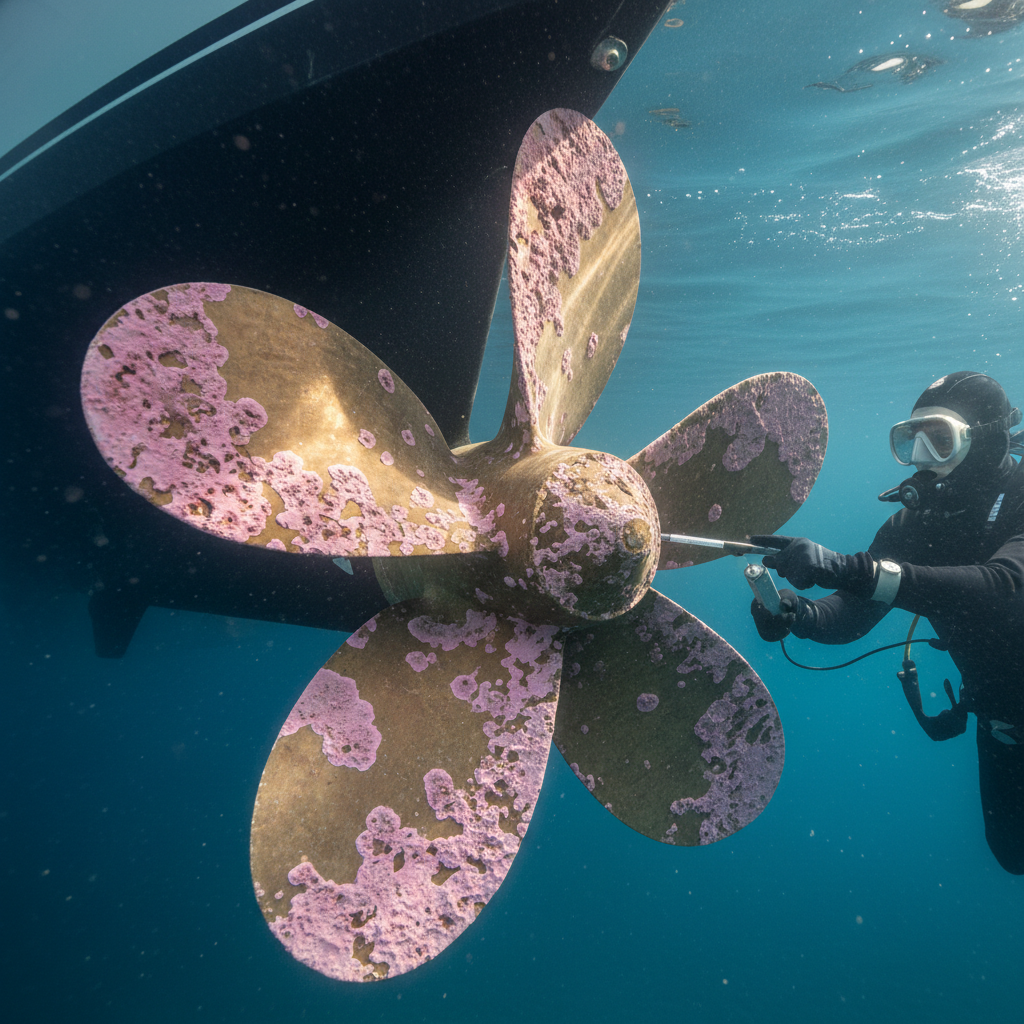
What most people miss is that even a brand-new boat can be at risk if the factory-installed isolator fails in a ‘shorted’ state. In our work with high-net-worth owners in Belvedere, we’ve seen $20,000 prop sets reduced to ‘pink’ swiss cheese because a neighbor’s water heater had a minor ground fault.
Step 1: The Visual Anode Assessment and Depletion Mapping
The first step in a galvanic isolation audit is reading the story your anodes are telling you about your boat’s electrical health. A healthy zinc or aluminum anode should wear evenly over 6 to 12 months; if yours are disappearing in 8 weeks, you have a major problem.
But wait—don’t just look at the size. Look at the texture. Brittle, bright white buildup on a zinc indicates it’s working but potentially overworked. If the metal underneath is crumbling, the sacrificial anode lifespan is being artificially shortened by external electrical pressure. We recommend a professional hull cleaning schedule that includes photo documentation of these components every 3-4 weeks.
Key Indicators of Stray Current
- Rapid ‘pitting’ on stainless steel shafts.
- Blistering paint around underwater through-hull fittings.
- Anodes that look like they’ve been ‘burnt’ or have a charcoal-like texture.
The real kicker? Switching to eco-friendly aluminum anodes is often smarter in the Bay’s brackish water, but they require a higher level of monitoring to ensure they don’t ‘passivate’ and stop protecting the boat entirely.
Step 2: Shore Power Isolation and Isolator Health Testing
A galvanic isolation audit must verify that your isolator is actually blocking low-voltage DC currents while maintaining a safe AC ground. Many older units lack a status monitor, meaning they can fail without warning, leaving you completely unprotected while still plugged into the dock.
To test this, we use a digital multimeter to check the forward and reverse bias of the diodes within the isolator. If the reading is 0.0V in both directions, the unit is shorted. If it’s ‘Open’ in both directions, you’ve lost your safety ground—a massive liability risk. According to NFPA 70 (National Electrical Code) standards, maintaining this ground is critical for preventing electric shock drowning (ESD) in marinas.
| Test Parameter | Healthy Range | Failure Sign |
|---|---|---|
| Forward Bias (Diode Test) | 0.8V to 1.2V DC | 0.0V (Shorted) |
| Reverse Bias | Open / Infinite | Low Voltage Reading |
| Hull Potential (Silver/Silver-Chloride) | -550mV to -1100mV | Above -500mV (Under-protected) |
Need a professional eyes-on assessment of your underwater gear? Schedule your pre-season audit today to catch issues before they require a haul-out.
Step 3: The Hull Potential Survey (The Gold Standard)
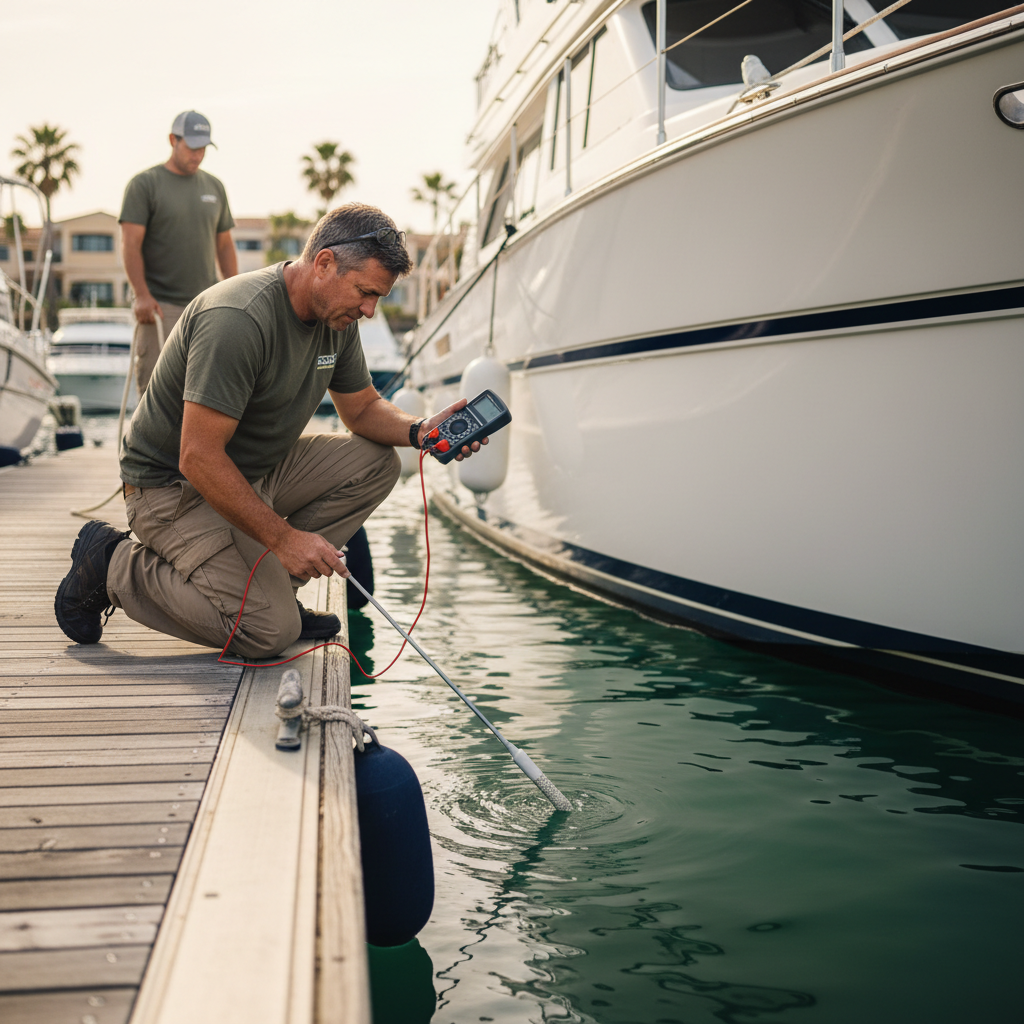
The final and most critical stage of the galvanic isolation audit involves a hull potential survey using a silver/silver-chloride reference electrode. This is the only way to scientifically prove if your boat is ‘over-protected,’ ‘under-protected,’ or ‘active’ in the galvanic scale.
In a typical Bay Area mid-market vessel scenario, we often find that boats are actually over-protected. While that sounds good, over-protection can cause ‘cathodic delamination’ of bottom paint and even embrittle high-strength steels. A precise Belvedere Cove yacht maintenance plan balances this potential perfectly.
Why Digital Monitoring is the Future
- Real-time tracking: New digital monitors can alert your phone if your hull potential drops because a new boat plugged in next door.
- Insurance Compliance: Many luxury marine insurers are beginning to look for proof of routine electrical audits in the event of a corrosion claim.
- Data-Driven Decisions: Stop guessing if you need more zincs; let the voltage readings tell you the truth.
The real insight most captains miss: your isolation transformer (if equipped) is superior to a galvanic isolator, but it generates heat and requires specific ventilation that often fails in the cramped engine rooms of older 40-50ft cruisers.
The ROI of Prevention: Audit vs. Emergency Repair
Let’s talk honest numbers. A comprehensive galvanic isolation audit and underwater inspection might cost a few hundred dollars. In contrast, replacing a pair of 24-inch nibral propellers and shafts damaged by stray current corrosion can easily exceed $15,000 when you factor in parts, labor, and emergency haul-out fees at a local yard.
For high-performance vessels frequented in Belvedere waterfront maintenance circles, the risk is even higher. High-flow areas like the Raccoon Strait increase the oxygenation of the water, which further accelerates the chemical reaction of corrosion. If you aren’t auditing your system annually, you are essentially gambling with your running gear.
At 360 Hull Diving, we provide before-and-after photo proof with every service, ensuring you see exactly how your anodes are performing. Learn more about our zinc and corrosion protection services.
Smart Marina Compliance and Future Standards
As marinas like those in Belvedere and Tiburon upgrade to newer ABYC E-11 Standards, they are installing more sensitive Ground Fault Protection (GFP) breakers on the docks. If your boat has a ‘leaky’ electrical system, you won’t just be corroding your hull—you’ll be the person tripping the dock power for everyone else.
The best way to stay in the good graces of your harbormaster and your neighbors is to ensure your vessel is electrically ‘quiet.’ This means no DC current leaking into the AC ground and a perfectly functioning isolation setup. We use our internal AI content engine, Ingest.blog, to track these shifting maritime regulations and keep our clients informed of new compliance requirements before they become a headache at the dock.
Your Monday Morning Action Plan
- Walk down to your boat and check your shore power cord for any signs of overheating at the plug.
- Check your galvanic isolator’s status light (if it has one).
- Call your dive team and ask for a specific ‘anode depletion report’ from your last cleaning.
Don’t let your yacht become the sacrificial lamb for the marina’s electrical gremlins. A proactive galvanic isolation audit is the smartest investment you can make this season. Ready for peace of mind? Contact 360 Hull Diving today for a professional assessment with photo proof.
Frequently Asked Questions
How often should I perform a galvanic isolation audit?
We recommend a full audit once a year, ideally during your pre-season recommissioning. However, if you notice your anodes are depleting in less than 4 months, or if a new boat moves into the slip next to you, you should perform a check immediately to rule out new stray current sources.
Can I just add more zincs to stop stray current corrosion?
No. Adding more anodes is a ‘band-aid’ that doesn’t fix the underlying electrical leak. In fact, over-zincing can lead to ‘over-protection,’ which can damage your bottom paint and certain metal alloys. A proper audit identifies the source of the current so it can be blocked at the isolator.
What is the difference between a galvanic isolator and an isolation transformer?
A galvanic isolator is a solid-state device that blocks low-voltage DC current while allowing AC ground to pass. An isolation transformer completely disconnects your boat’s electrical system from the shore’s ground, providing the highest level of protection, though they are much heavier and more expensive.
Why is my boat corroding even though I’m not plugged into shore power?
This usually indicates an internal ‘bonding’ issue where different metals on your own boat (like a bronze thru-hull and a stainless shaft) are creating their own battery. A hull potential survey during your audit will identify if the problem is coming from inside the boat or from the marina.