
📋 Table of Contents
Optimizing boat fuel efficiency is no longer just a matter of performance; it is a critical financial strategy for Bay Area vessel owners facing record-high marine fuel prices in 2026. Whether you are cruising from the high-salinity docks of Sausalito or navigating the rugged coast toward Half Moon Bay, the invisible layer of slime on your hull is costing you thousands in unnecessary drag.
The Hidden Cost of Micro-Friction on Boat Fuel Efficiency
According to recent maritime studies by The Maritime Executive, even a light layer of slime—often referred to as micro-fouling—can increase fuel consumption by up to 20%. For a 40-foot motor yacht cruising at 20 knots, this translates to a significant ‘ghost passenger’ dragging behind your boat. In the San Francisco Bay, where water temperatures and nutrient levels fluctuate, this growth happens faster than most owners realize.
- The 2-Week Richardson Bay Audit: A vessel sitting idle for just 14 days in Sausalito can lose 1.5 knots of top-end speed due to early-stage biofilm.
- The Fuel Penalty: At current 2026 prices of $6.50+ per gallon at local marinas, that loss in efficiency represents a direct tax on every nautical mile.
- Engine Strain: Increased drag forces your engines to work harder to maintain cruising speed, accelerating wear on expensive mechanical components.
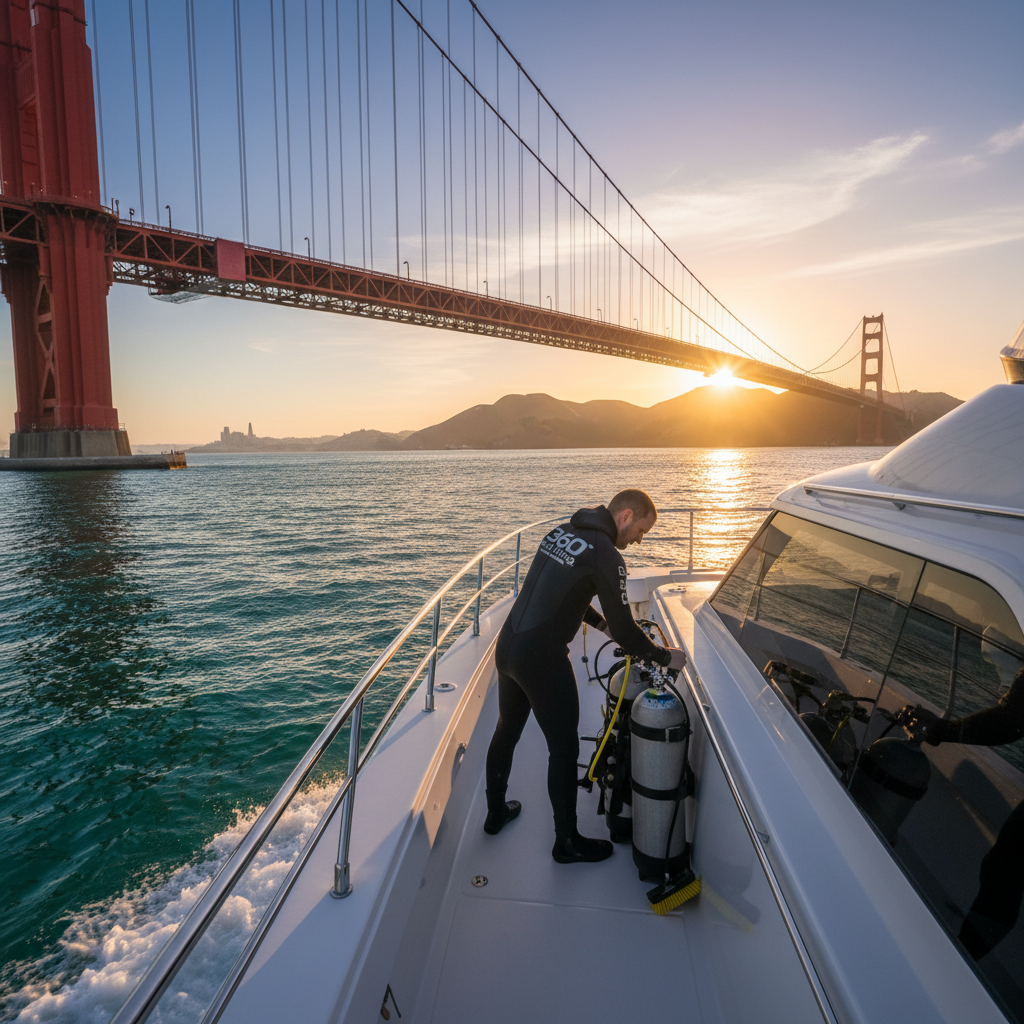
Sausalito to Half Moon Bay: Navigating the Local Salinity Gradient
To maximize boat fuel efficiency, owners must understand that the San Francisco Bay is not a uniform environment. The salinity levels in Richardson Bay promote aggressive barnacle attachment, while the colder, open-ocean waters near Pillar Point Harbor in Half Moon Bay introduce different organic pressures. This gradient dictates how often your hull requires professional attention to maintain peak performance.
- Sausalito (High Salinity): Warm, shallow pockets in marinas like Clipper Yacht Harbor act as incubators for hard growth.
- Central Bay (High Flow): Strong currents help keep some debris off, but the high nutrient content feeds rapid algae blooms.
- Half Moon Bay (Cold Open Ocean): While barnacle growth may slow, heavy kelp and cold-water organisms can cling to running gear, causing severe vibration and drag.
Strategic owners utilize local marina maintenance schedules to stay ahead of these regional shifts. By tailoring your cleaning frequency to your specific slip location, you ensure that your bottom paint performs as intended.
Quantifying Hull Cleaning Savings: The ROI of a Clean Bottom
The financial case for hull cleaning savings is undeniable when viewed through the lens of a $1M+ revenue business mindset. Professional maintenance isn’t an expense; it is a high-yield investment in asset preservation. By removing the ‘hidden fuel tax’ of bio-fouling, you directly improve your vessel’s ROI while extending the life of your anti-fouling coatings.
| Fouling Level | Drag Increase (%) | Est. Fuel Cost Increase (Annual) | Performance Impact |
|---|---|---|---|
| Light Slime | 10-15% | $1,200 – $2,500 | Minor RPM increase needed |
| Heavy Slime/Grass | 20-35% | $3,000 – $6,000 | Significant speed loss |
| Hard Growth (Barnacles) | 40-80% | $8,000+ | Engine overheating risk |
Furthermore, the shift toward EPA-compliant cleaning practices means that professional Bay Area marine services now use specialized tools that preserve your bottom paint rather than scrubbing it away. This extends the interval between expensive haul-outs, providing secondary hull cleaning savings that often exceed the cost of the monthly dive service itself.
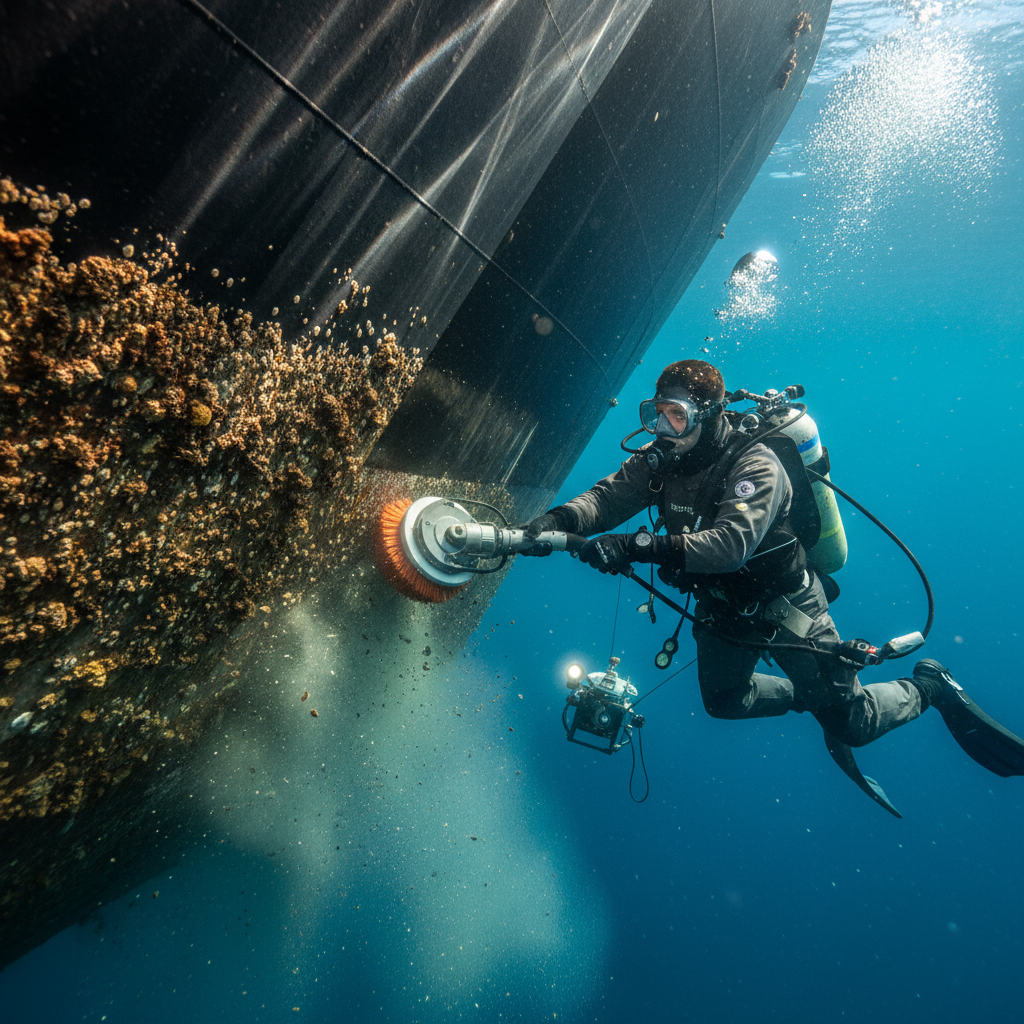
Environmental Stewardship and the Carbon Tax of Drag
Modern executives are increasingly focused on their personal carbon footprints and ESG (Environmental, Social, and Governance) values. A fouled hull isn’t just a financial drain; it is an environmental hazard. Increased fuel burn directly correlates to higher CO2 emissions, making regular hull maintenance a core component of sustainable boating in California.
- Reduced Carbon Footprint: A clean hull can reduce a vessel’s annual CO2 output by several tons, depending on usage.
- Invasive Species Prevention: Regular cleaning prevents the transport of invasive species between the Bay and the sensitive ecosystems of the Pacific coast.
- Regulatory Compliance: California’s tightening regulations on copper leach runoff make it imperative to use certified divers who understand how to clean without damaging the environment.
Consequently, choosing a diver who provides photo proof of zinc and hull condition ensures you are meeting both financial and ethical standards. Transparency in service is the new benchmark for elite Bay Area marine services.
Predictive Maintenance: Timing the Spring Bloom
As of 2026, El Niño-driven water temperature shifts have caused unprecedented growth rates in the San Francisco Bay. Waiting for a scheduled quarterly clean is no longer sufficient for maintaining boat fuel efficiency. Predictive maintenance involves using local water temperature data to time your scrubs before the massive spring blooms take hold.
Specifically, when water temperatures in the Bay rise above 58°F, barnacle reproduction hits its peak. During these windows, a three-week cleaning cycle may be necessary to prevent hard growth from cementing onto your running gear. This proactive approach is the hallmark of sophisticated owners who value convenience and long-term asset health.
The 360 Hull Diving Advantage: Transparency Through Technology
At 360 Hull Diving, we recognize that business leaders demand data, not just promises. Our unique value proposition centers on providing before-and-after photo proof with every service. This transparency allows you to see the exact state of your running gear and the effectiveness of your boat fuel efficiency strategy.
Whether your boat is docked in Richmond, San Francisco, or South Beach, our team provides the detailed reporting necessary to track your hull cleaning savings over time. We treat your vessel like the high-performance asset it is, ensuring that every trip to Half Moon Bay is as efficient and enjoyable as possible.
Key Takeaways for Bay Area Boaters
- Micro-fouling can increase fuel costs by over 20% in as little as two weeks.
- The salinity gradient between Sausalito and the coast requires a localized maintenance strategy.
- Professional hull cleaning is a high-ROI activity that extends the life of bottom paint and engines.
- Photo-documented service is essential for verifying hull condition and zinc health.
Frequently Asked Questions
How much does a fouled hull actually affect my boat fuel efficiency?
Even light biofilm or ‘slime’ can increase drag by 10-15%, while hard growth like barnacles can increase fuel consumption by over 40%. For Bay Area boaters, this translates to hundreds of dollars in extra fuel costs on a single trip from Sausalito to Half Moon Bay at current prices.
Why is hull cleaning more critical in Sausalito than in other parts of the Bay?
Sausalito’s Richardson Bay has higher salinity and shallower, warmer water pockets compared to the deeper Central Bay. These conditions act as a catalyst for rapid barnacle and algae growth, requiring more frequent cleanings to maintain optimal boat fuel efficiency and performance.
Can I use ultrasonic anti-fouling instead of regular hull cleaning?
While ultrasonic systems can inhibit some growth, they are rarely a 100% solution in the nutrient-rich waters of the San Francisco Bay. Most owners find that a combination of modern anti-fouling paint, ultrasonic technology, and regular professional Bay Area marine services provides the best hull cleaning savings.
Is in-water hull cleaning legal in California given the strict copper regulations?
Yes, in-water cleaning is legal provided it is performed by insured professionals using Best Management Practices (BMPs). These techniques focus on removing growth without ‘scrubbing’ the paint, which minimizes copper plume runoff and protects both your boat’s coating and the Bay’s water quality.