
📋 Table of Contents
For recreational boat owners navigating the San Francisco Bay, the cost of ownership often feels like a series of mounting surcharges. However, the most significant drain on your wallet isn’t the slip fee—it is the hull cleaning fuel efficiency penalty caused by aggressive local biofouling. Whether you are docked in Sausalito or the Richmond Marina, your vessel is currently engaged in a silent, expensive battle with Northern California’s unique aquatic ecosystem.
The Economic Impact of Hull Cleaning Fuel Efficiency
As of 2024, marine fuel prices at major Bay Area hubs remain volatile, making every gallon precious. When your hull is covered in slime, barnacles, or tube worms, your engine must overcome massive frictional resistance. This isn’t just a performance issue; it is a direct financial hit that functions like a hidden tax every time you leave the dock.
- Increased Drag: Even a thin layer of micro-fouling (slime) can increase hull friction by up to 10%.
- Engine Strain: Hard growth, like the barnacles found in the Carquinez Strait, can force engines to work 20% harder to maintain cruising speed.
- Fuel Burn: Data suggests that untreated hulls lead to a 15-25% spike in hourly fuel consumption.

Quantifying the ‘Hidden Fuel Tax’
Furthermore, the brackish waters of the San Pablo Bay create a high-growth environment that accelerates fouling faster than in many other coastal regions. Consequently, boaters who skip a single monthly cleaning often find their fuel economy has plummeted before they even realize the growth has taken hold. By prioritizing hull cleaning fuel efficiency, you are essentially giving yourself a 15% discount at the fuel dock.
Why San Francisco Bay Marine Growth is Uniquely Aggressive
The San Francisco Bay is not a monolith; it is a complex estuary with varying salinity levels that dictate San Francisco Bay marine growth patterns. From the high-salinity waters near the Golden Gate to the brackish flows of the Delta, different organisms thrive in different marinas. Understanding these local nuances is critical for maintaining boat maintenance costs at a manageable level.
- The Salinity Gradient: Marinas in Berkeley and Emeryville see different species than those in the freshwater-heavy Carquinez Strait.
- El Niño Effects: Recent climate shifts have warmed Northern California waters, leading to longer and more intense growing seasons for invasive species.
- Nutrient Loading: Runoff from the surrounding hills provides a feast for algae, leading to rapid ‘slime’ development within days of a cleaning.
The Role of Invasive Species in the Delta
Additionally, maintaining a clean hull is a matter of environmental biosecurity. According to California Department of Fish and Wildlife, invasive species spread through the Delta via fouled hulls. By investing in regular service, you protect the local ecosystem while simultaneously improving your hull cleaning fuel efficiency.
Calculating the ROI of Underwater Hull Cleaning Bay Area
Many owners view divers as a luxury expense, but the math tells a different story. When you compare the cost of a professional dive service against the marine biofouling fuel penalty, the service often pays for itself in just two or three outings. This is especially true for high-displacement vessels and performance cruisers.
| Vessel Type | Monthly Cleaning Cost (Avg) | Estimated Fuel Savings (Quarterly) | Net ROI |
|---|---|---|---|
| 30′ Sailboat | $120 – $180 | $350 – $500 | +140% |
| 45′ Motor Yacht | $200 – $300 | $800 – $1,200 | +220% |
| Commercial Trawler | $400+ | $2,500+ | +500% |
The Cost of Inaction vs. Proactive Maintenance
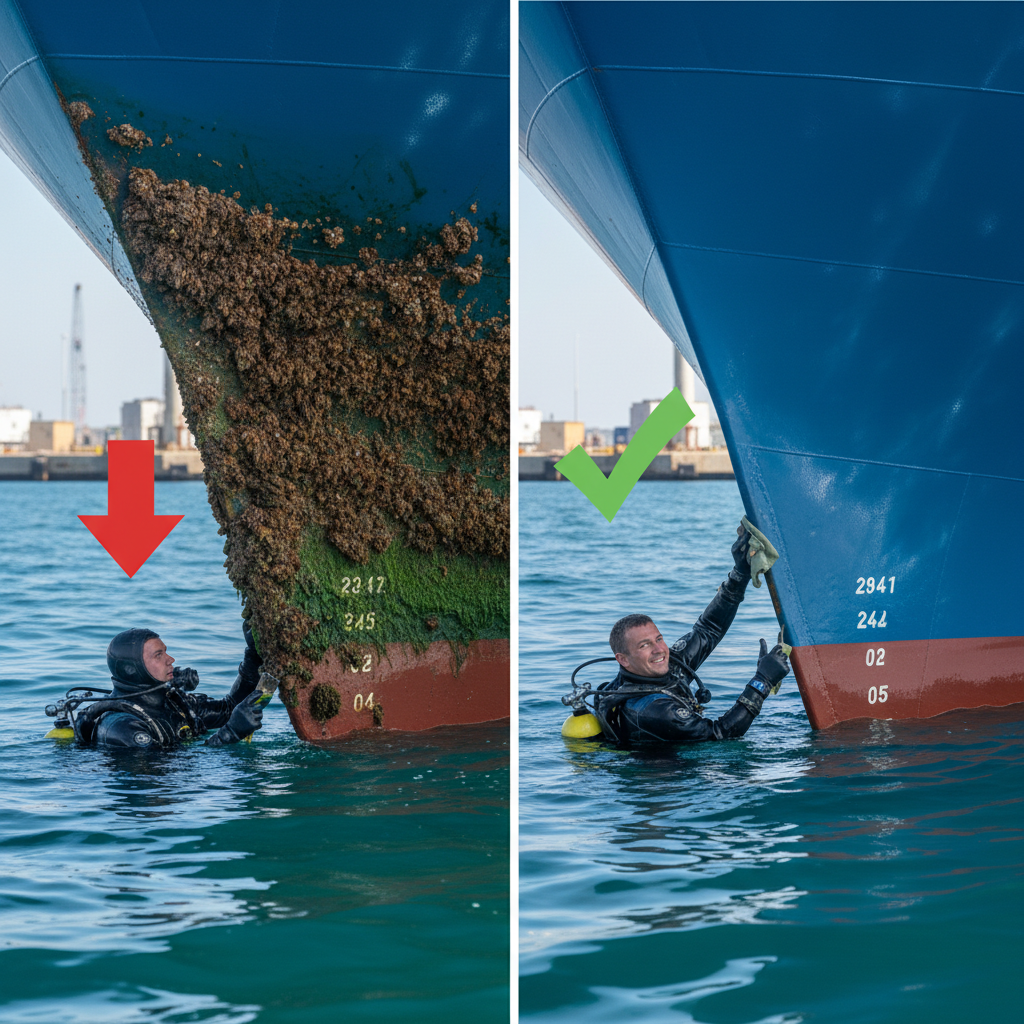
Moreover, reactive maintenance—waiting until the boat feels “sluggish”—is the most expensive way to manage a vessel. By then, the hard growth has likely damaged your anti-fouling paint, leading to a much higher boat maintenance costs during your next haul-out. Proactive monthly cleaning ensures that vessel drag reduction is maximized year-round.
Propeller Polishing and Running Gear Efficiency
While the hull surface area is large, your running gear is where the power meets the water. A fouled propeller is a primary culprit for poor hull cleaning fuel efficiency. Even a small cluster of barnacles on a prop can cause cavitation, vibration, and a massive drop in thrust-to-fuel ratio.
- Thrust Optimization: Smooth blades allow for laminar flow, ensuring every RPM translates into forward motion.
- Vibration Reduction: Removing growth prevents unbalanced loads on your shaft and transmission.
- Zinc Protection: Regular diver inspections ensure your sacrificial anodes are intact, preventing costly galvanic corrosion.
Micro-fouling: The Silent Performance Killer
Interestingly, many boaters ignore the “slime” layer, thinking only barnacles matter. However, research from MARAD indicates that micro-fouling alone can account for a 10% increase in drag. In the competitive waters of the St. Francis Yacht Club or the Tiburon Peninsula, that 10% is the difference between a smooth ride and a frustrating slog.
Navigating California’s Strict Environmental Regulations
Operating a boat in the Bay Area means adhering to some of the nation’s strictest environmental standards. The California Air Resources Board (CARB) and local water boards have specific views on hull runoff. Professional underwater hull cleaning Bay Area services use Best Management Practices (BMPs) to ensure compliance.
- Soft Cleaning Techniques: We use specialized tools to remove growth without scrubbing off your expensive anti-fouling paint.
- Eco-Friendly Compliance: Our methods minimize the release of copper and biocides into the San Francisco Bay.
- Photo Documentation: We provide before-and-after proof, ensuring you have a record of your vessel’s condition for insurance or resale.
The Carbon Footprint Connection
Furthermore, reducing fuel burn isn’t just about money—it’s about your carbon footprint. A clean hull is the easiest way for a recreational boater to contribute to a cleaner San Francisco. By improving your hull cleaning fuel efficiency, you are directly reducing the emissions produced by your vessel during every transit to Angel Island or the Farallones.
Conclusion: Stop Paying the Hidden Fuel Tax
Ultimately, the health of your vessel and your bank account depends on what is happening beneath the waterline. Don’t let the aggressive San Francisco Bay marine growth dictate your weekend plans or your monthly budget. With professional, insured dive services that provide transparent photo proof, you can reclaim your performance and stop overpaying at the pump.
Ready to see the difference? Book your hull inspection today and start saving on your boat maintenance costs immediately. At 360 Hull Diving, we serve marinas across Sausalito, Richmond, and San Francisco with the precision your vessel deserves.
Frequently Asked Questions
How much fuel can I really save with a clean hull?
Most recreational boaters in the Bay Area see a 15-20% improvement in fuel efficiency after a professional cleaning. This varies based on the level of fouling. For vessels in high-growth areas like San Pablo Bay, the savings can be even higher as the engine no longer has to fight extreme frictional drag.
How often should I have my hull cleaned in the San Francisco Bay?
We recommend a monthly cleaning schedule for most Bay Area marinas. Due to our unique salinity and nutrient levels, growth begins within days. A 4-week interval prevents hard growth from attaching, which protects your anti-fouling paint and maintains peak hull cleaning fuel efficiency year-round.
Does a thin layer of slime actually affect my boat’s performance?
Yes, absolutely. This is known as micro-fouling, and it can increase vessel drag by up to 10%. While it may not look as dramatic as barnacles, it creates a turbulent boundary layer that forces your engine to burn more fuel to maintain the same speed through the water.
Are your cleaning methods safe for my anti-fouling paint?
Our team uses specialized, non-abrasive techniques designed to remove organic growth while leaving your paint intact. By cleaning more frequently with softer tools, we actually extend the life of your bottom paint by preventing the need for the heavy scrubbing required to remove mature barnacles.
Do you provide proof of the service?
Transparency is our core value. Every service includes before-and-after photo documentation. This allows you to see the exact state of your hull, running gear, and zincs from the comfort of your home or office, ensuring you know exactly what you are paying for.