📋 Table of Contents
According to recent maritime insurance data, over 50% of preventable sinkings at the dock are caused by failed underwater fittings that owners didn’t even know existed. For a new owner at a busy marina like South Beach Harbor, underwater component mapping isn’t just a technical exercise—it is the only way to verify your boat is safe without diving into the chilly Bay waters yourself.
Key Takeaways for Bay Area Owners
- Transparency: Use photo-documented mapping to verify that every intake and zinc was actually serviced.
- Efficiency: Reducing biofouling through mapped maintenance can improve fuel economy by up to 15% according to the EPA’s maritime guidelines.
- Compliance: Digital mapping helps meet strict California biosecurity regulations regarding invasive species.
1. The Inventory Phase: Identifying Your Thru-Hull Maintenance Needs
The first step in any strategic maintenance plan is knowing exactly where your vulnerabilities lie beneath the waterline. Most owners rely on a vague mental map, but a professional-grade underwater component mapping strategy requires a precise inventory of every thru-hull, transducer, and cooling intake.
What most people miss: Your owner’s manual is often wrong because previous owners may have added or plugged fittings over the years. We recommend starting with an internal audit. Trace every hose from your engines, generators, and heads to where they exit the hull. This creates a “digital twin” logic for your vessel before the first diver even splashes.
- Main Engine Intakes: Usually the largest and most prone to heavy biofouling.
- Air Conditioning Pickups: Small but critical; a single barnacle here can kill your AC on a hot day.
- Transducers: Delicate sensors that require “soft-cleaning” to avoid signal interference.
- Speed Logs: Paddle wheels that seize up instantly without regular attention.
2. Digital Documentation and ROV Hull Inspection
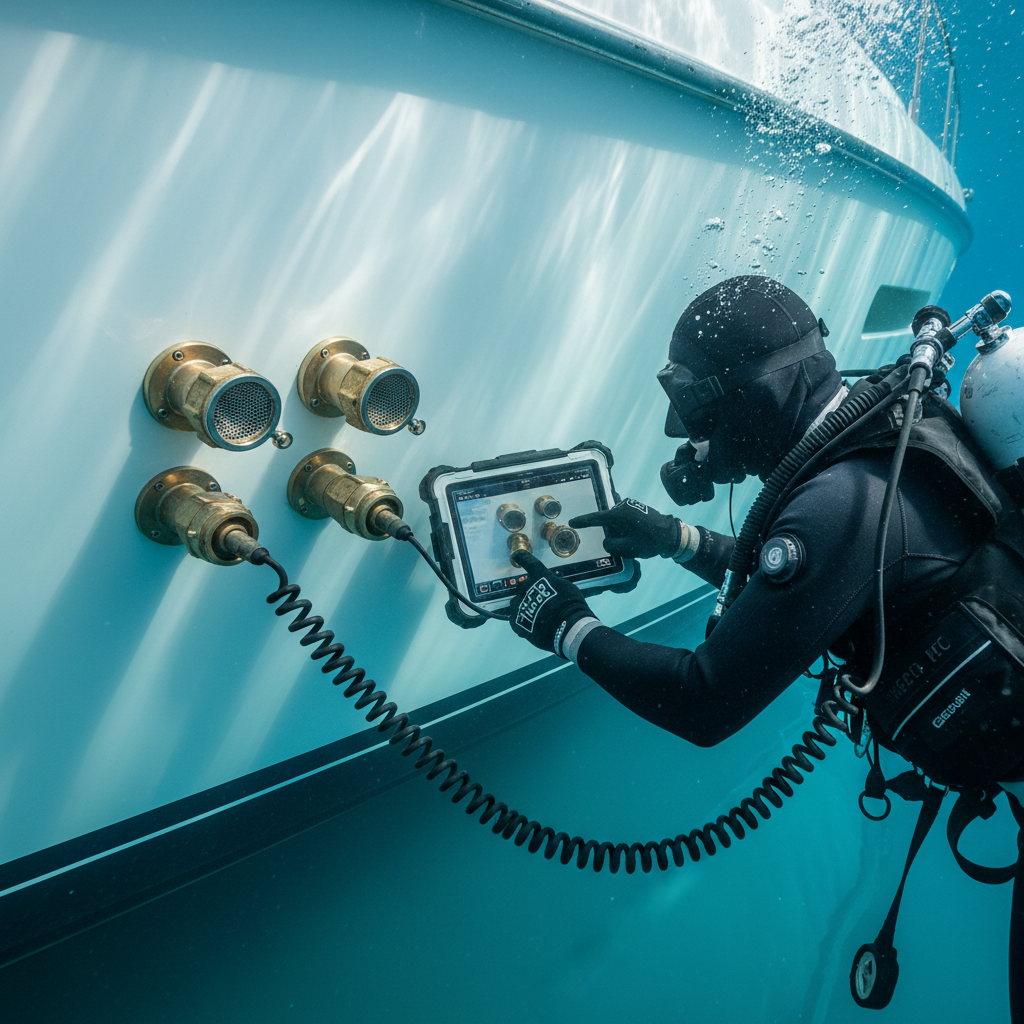
Visual proof is the only currency that matters when it comes to underwater work. While many old-school divers still rely on “feel,” modern South Beach Harbor boat care standards utilize smartphone-operated ROVs (Remotely Operated Vehicles) to provide high-definition video of your running gear.
Here’s the thing: A professional ROV hull inspection provides a baseline for your boat’s “Digital Health Record.” This documentation is invaluable for insurance compliance and can significantly boost resale value. When a buyer sees a three-year history of photo-documented thru-hull maintenance, the “fear of the unknown” evaporates. If you’re managing a fleet or a high-end yacht, this level of detail is no longer optional—it’s expected.
Need a professional eyes-on-hull report? Schedule your baseline mapping session today.
3. Sacrificial Anode Mapping and Corrosion Strategy
Corrosion is a silent, expensive enemy that moves faster in the highly conductive brackish waters of the San Francisco Bay. A core pillar of underwater component mapping is identifying every single sacrificial anode—from the large hull plates to the tiny “pencil zincs” hidden inside thruster tunnels.
| Component | Anode Material | Typical Lifespan (SF Bay) |
|---|---|---|
| Propeller Shafts | Zinc or Aluminum | 3-4 Months |
| Saildrives | Specialty Aluminum | 6 Months |
| Trim Tabs | Zinc Plates | 4-5 Months |
The real kicker? Using the wrong metal can actually accelerate damage. For example, if you’re moored at a marina with stray electrical current issues, standard zincs might “passivate” and stop working. A mapped approach allows us to track the depletion rate of each anode, moving you from reactive repairs to a predictive maintenance model.
4. Verifying Performance with a Post-Service Audit
The final step in the framework is the audit—comparing your “before” map to the “after” results. This is where 360 Hull Diving sets itself apart by providing photo proof of every service. For thru-hull maintenance, this means seeing clear, unobstructed grates and polished running gear.
But wait—don’t just look for cleanliness. Look for anti-fouling coating health. Aggressive scrubbing can strip away expensive paint, leading to a “lemon” boat scenario where you’re paying for more frequent cleanings because the hull is now porous. We use eco-friendly soft-cleaning techniques to preserve your coating while removing the marine biofouling management challenges unique to the West Coast.
At 360 Hull Diving, we believe transparency is the ultimate luxury. Whether you’re at Berkeley Marina or Treasure Island, you deserve to know exactly what is happening under your feet. Learn more about our corrosion protection services.

The Contrarian Insight: Why “Monthly” Isn’t Always Best
Most dive services push a strict monthly schedule regardless of boat usage. In our work with high-performance Bay Area owners, we’ve found that a “mapped” schedule—adjusting frequency based on water temperature and seasonal growth spurts—actually saves money and extends the life of your hull paint. More isn’t always better; smarter is better. This is the same logic we use in our internal AI content engine, Ingest.blog, where we prioritize strategic quality over raw volume.
FAQs: Navigating Underwater Maintenance
How often should I update my underwater component map?
You should establish a baseline map immediately upon purchase or after a haul-out. Update the map annually or whenever you add new electronics like a 3D sonar transducer. Regular underwater hull survey updates ensure that no new thru-hulls are overlooked during routine cleanings.
Can I use a GoPro for my own ROV hull inspection?
While a GoPro on a pole can work in clear water, the visibility in the Bay often requires specialized lighting and stabilization. Professional underwater component mapping uses high-lumen LED arrays and 4K sensors to see through the murk, providing clear evidence for insurance or maintenance logs.
Does mapping help with fuel efficiency?
Absolutely. By mapping and specifically targeting propeller cavitation check points and intake obstructions, you ensure the engine isn’t working harder than necessary. Even small amounts of slime on a propeller can drop efficiency by 5-10%, making routine mapping a high-ROI activity.
What is the difference between zinc and aluminum anodes in the Bay?
This is a critical part of sacrificial anode mapping. In the brackish waters of many Bay Area marinas, aluminum anodes often provide better protection and last longer than traditional zinc. A map helps us track which material is performing best for your specific slip location.
Ready to Secure Your Vessel’s Future?
Don’t leave your boat’s safety to guesswork. Implementing this 4-step framework today ensures you are never surprised by a blocked intake or a corroded strut. Our team at 360 Hull Diving provides the professional expertise and photo-backed transparency you need to enjoy the water with total peace of mind.
Take the first step toward a smarter maintenance routine. Contact 360 Hull Diving today for a comprehensive underwater component mapping and estimate.