
📋 Table of Contents
Navigating the Mare Island Strait requires surgical precision, yet many Vallejo boaters ignore the silent vibration in their helm until the rudder bearing stress test reveals a catastrophic failure. According to data from BoatUS, steering failure remains a top-five cause for emergency towing, often resulting from gradual wear that goes undetected during standard visual checks.
For members at the Vallejo Yacht Club, the stakes are uniquely high. The convergence of heavy siltation from the Napa River and the aggressive tidal swings of San Pablo Bay creates a grinding paste that accelerates pintle and gudgeon wear. If you’ve felt a slight ‘thunk’ when crossing a wake or noticed the autopilot struggling to maintain a heading in a following sea, your system is already talking to you.
Key Takeaways for VYC Members
- Early Detection: Identifying bearing play now prevents a $5,000+ emergency haul-out later.
- Local Stressors: San Pablo Bay’s brackish water and high silt levels act as an abrasive on composite bearings.
- The 3-Point Method: Focus on the rudder stock, the blade center-of-effort, and the bearing housing.
- Proof of Service: Always demand before-and-after photo evidence of underwater inspections.
1. Why Vallejo Currents Mask Early Steering Failure
The real kicker? The heavy currents in the North Bay often provide a false sense of steering tension that masks mechanical looseness until the bearing reaches a breaking point. What most people miss is that the constant pressure of moving water keeps the rudder pressed against one side of the housing, hiding the ‘slap’ you would normally feel in calmer waters.
In our work with recreational boat owners at Bay Area marinas, we frequently find that silt accumulation in the rudder port packing acts as a temporary shim. This sediment fills the gaps created by wear, making the steering feel tight at the dock while the internal components are actually vibrating themselves to pieces. As of 2025, predictive maintenance has shifted from ‘time-based’ to ‘condition-based,’ making the underwater steering inspection a critical seasonal requirement.
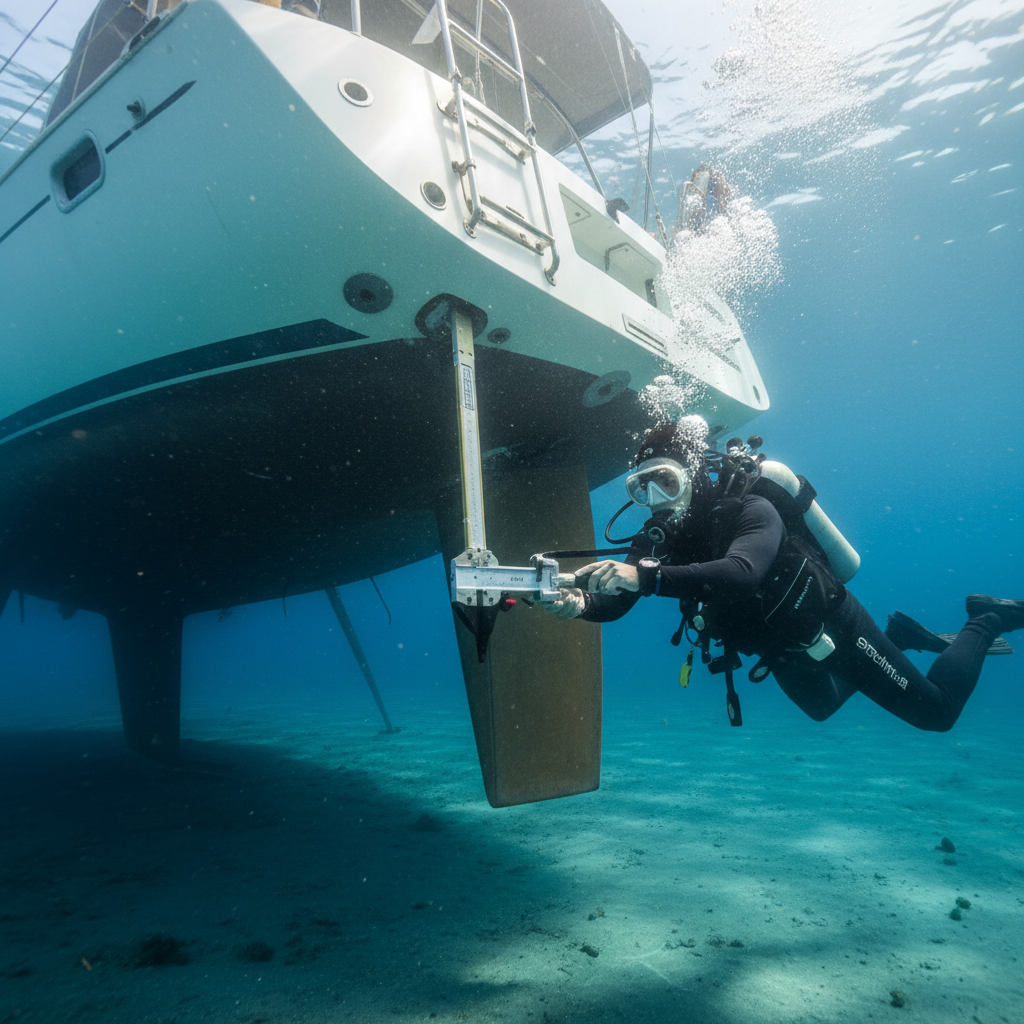
2. The Framework: Executing the Rudder Bearing Stress Test
A successful rudder bearing stress test isn’t just about wiggling the blade; it’s a systematic measurement of deflection across three specific geometric planes. By isolating these points, you can distinguish between simple steering cable slack and genuine marine bearing clearance issues that require professional intervention.
- The Upper Stock Pivot: Checking for lateral movement where the rudder post enters the hull.
- The Mid-Blade Deflection: Applying torque to the center of the rudder to test for internal structural delamination.
- The Lower Bearing/Shoe Gap: Measuring the vertical and horizontal play at the lowest point of support.
While some owners attempt a DIY check using a GoPro on a stick, the lack of tactile feedback often leads to a false sense of security. A professional underwater hull inspection in California provides the physical force necessary to simulate the 4-6 knots of pressure your rudder faces under load. Need an expert eyes-on assessment? Schedule your professional dive inspection today to see what’s happening beneath the waterline.
3. Impact of San Pablo Bay Salinity on Bearing Wear
The brackish water of the North Bay creates a unique chemical environment that can cause composite bearings to swell or undergo accelerated hydrolysis. Unlike the pure saltwater of the Central Bay, the fluctuating salinity levels near Vallejo can cause certain nylon and plastic bushings to lose their dimensional stability over time.
| Bearing Material | Silt Resistance | Salinity Sensitivity | Typical Lifespan (VYC) |
|---|---|---|---|
| Bronze/Brass | Moderate | Low | 8-12 Years |
| Nylon/Plastic | Low | High (Swelling) | 4-6 Years |
| Vesconite/Composite | High | Low | 10+ Years |
What many owners overlook is that Vallejo Yacht Club maintenance requires a different approach than boats moored in Sausalito. The higher sediment load means your rudder bearing stress test should specifically look for scoring on the stainless steel stock, which can act like a file against the bearing surface. According to the EPA’s Vessel General Permit guidelines, maintaining mechanical integrity is also a key part of preventing lubricant discharge into sensitive estuarine environments.
4. Identifying Steering System Play Tolerances
Here’s the thing: not all ‘play’ is bad, but knowing the difference between a 1mm tolerance and a 5mm failure is what saves you from a mid-channel emergency. For most modern spade rudders, any lateral movement at the tip exceeding 1/4 inch is a signal that the marine bearing clearance has been compromised.
The real danger lies in the ‘harmonic vibration’ that occurs when a loose rudder oscillates at high speeds. This doesn’t just wear the bearing; it stresses the entire hull grid and can eventually lead to rudder port packing leaks. In a typical Bay Area mid-market yacht, we often see these vibrations go unnoticed until the autopilot pump starts drawing twice the normal amperage to compensate for the erratic movement.
5. The Cost-Benefit of Proactive Underwater Steering Inspection
The contrarian truth? Most boat yards will tell you to haul out the moment you feel a vibration, but a $200-$300 underwater steering inspection can often prove that the issue is a simple fouled zinc or a loose steering quadrant bolt—repairs that don’t require a $2,000 haul-out and week of yard fees. By using a local, insured dive team, you get the photo proof needed to make an informed decision.
At 360 Hull Diving, we provide high-resolution before-and-after imagery of every rudder bearing stress test. This transparency ensures you aren’t paying for ‘ghost repairs’ or unnecessary yard time. Our internal AI content engine, Ingest.blog, helps us document these common failure patterns across the North Bay to better educate our clients on predictive maintenance. If you’re concerned about your steering response, don’t wait for the next storm—contact us for a clear, documented assessment of your vessel’s health.
6. Pre-Season Readiness: A Checklist for VYC Owners
Before the summer racing season or your next trip up the Delta, perform these basic checks at the dock to see if you need a professional rudder bearing stress test:
- The ‘Hand-Feel’ Test: With the engine off, turn the wheel slowly. Any ‘dead spots’ or clicking?
- Visual Post Check: Look at the rudder post inside the lazarette. Is there any evidence of saltwater ‘weeping’ or rust staining around the seal?
- The Vibration Audit: At cruising RPM, place your hand on the steering pedestal. Excessive buzzing is a red flag for pintle and gudgeon wear.
Taking these steps this week can mean the difference between a relaxing sunset cruise and a stressful call to Vessel Assist. We’ve seen too many seasons cut short by deferred maintenance that could have been caught with a simple 20-minute dive. Stay ahead of the silt and the salt by making underwater inspections a standard part of your Vallejo Yacht Club maintenance routine.
FAQs: Navigating Steering Maintenance in the North Bay
How often should a rudder bearing stress test be performed?
For boats kept at the Vallejo Yacht Club or similar high-silt environments, we recommend a professional rudder bearing stress test at least twice a year. The abrasive nature of the Napa River runoff can accelerate wear significantly faster than in the cleaner, deeper waters of the Central Bay.
Can I check my own rudder bearings while the boat is in the water?
While you can check for obvious movement by hand, a true underwater steering inspection requires meaningful leverage and professional visibility. Divers use specialized tools to measure marine bearing clearance accurately, providing photo evidence that a surface-level ‘wiggle’ simply cannot match.
What are the signs of rudder port packing failure?
The most common sign is active dripping or a ‘salt crust’ build-up around the rudder post inside your bilge. If the rudder bearing stress test shows excessive play, it’s likely that the movement is also distorting the packing gland, which can lead to significant water ingress over time.
Does insurance cover rudder bearing replacement?
Most marine insurance policies view bearing wear as ‘wear and tear,’ which is typically excluded. However, having a documented history of underwater hull inspection in California can be vital if a failure leads to a secondary accident, as it proves you exercised due diligence in maintaining the vessel.