
📋 Table of Contents
According to the International Maritime Organization (IMO), even minor propeller surface roughness can increase fuel consumption by up to 6% due to hydrodynamic drag. For sailors navigating the high-current waters of the Raccoon Strait or docking at Clipper Yacht Harbor, propeller pitch verification is the difference between a smooth sunset cruise and a bone-rattling engine failure.
Key Takeaways:
- Identify pitch misalignment through specific RPM drops and vibration patterns.
- Leverage in-water diagnostics to avoid the $1,000+ cost of an unnecessary haul-out.
- Understand how Sausalito’s unique salinity levels accelerate calcification and ‘hidden drag.’
1. The Science of Propeller Pitch Geometry in San Francisco Bay
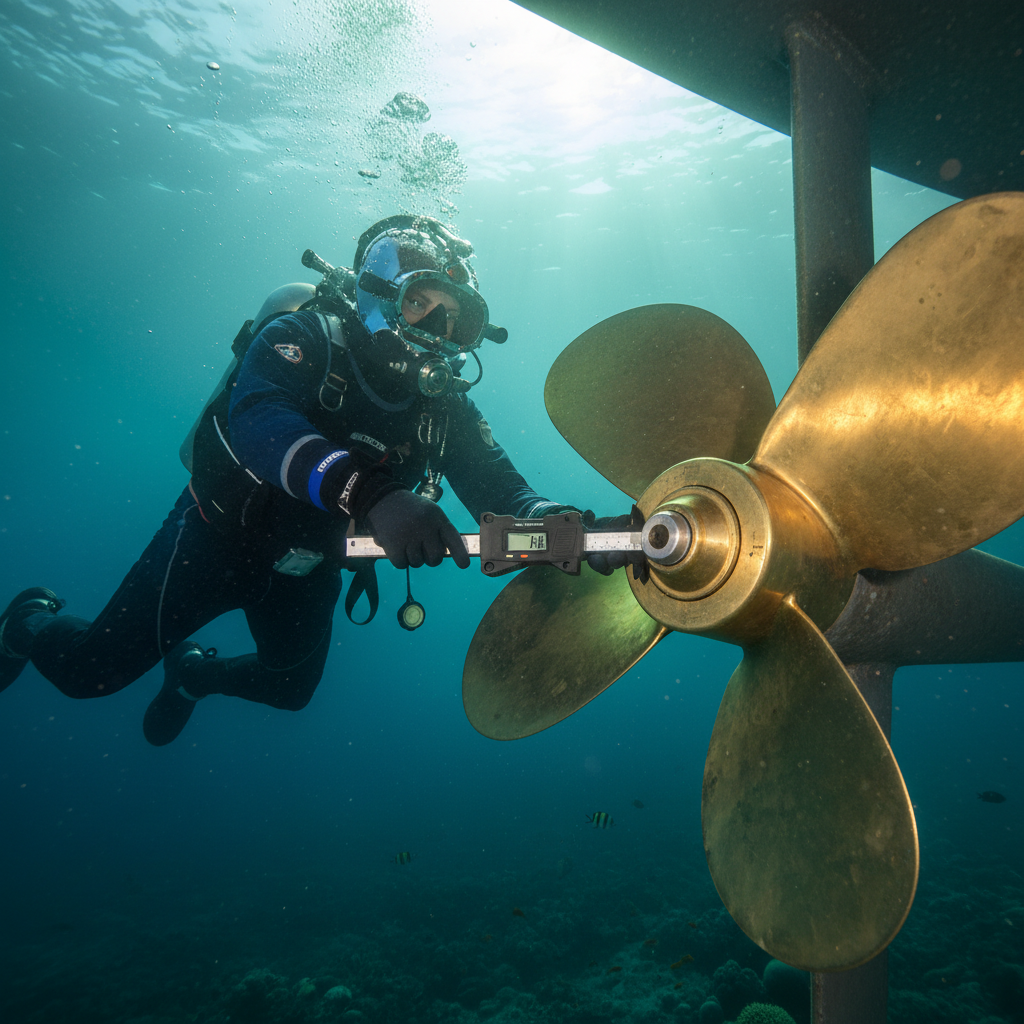
The real kicker is that most boat owners assume their vibration issues are purely mechanical, when they are often hydrodynamic. Propeller pitch geometry refers to the theoretical distance a propeller would move forward in one revolution; if your blades aren’t synchronized, your engine fights itself.
In our work with high-performance recreational vessels, we frequently find that even a 1/4-inch deviation in pitch between blades can trigger significant cavitational erosion. This is especially true in Sausalito, where the heavy tidal flow of Richardson Bay introduces debris that can subtly bend blade tips without the owner ever feeling a distinct ‘impact.’
- Pitch Consistency: Every blade must move the same volume of water to maintain drivetrain balance.
- Cavitational Erosion: Misaligned pitch creates low-pressure bubbles that implode against the metal, pitting your expensive running gear.
- The Salinity Factor: High salinity in the North Bay accelerates the calcification of barnacle bases, which can physically alter the effective pitch of a blade if not cleaned properly.
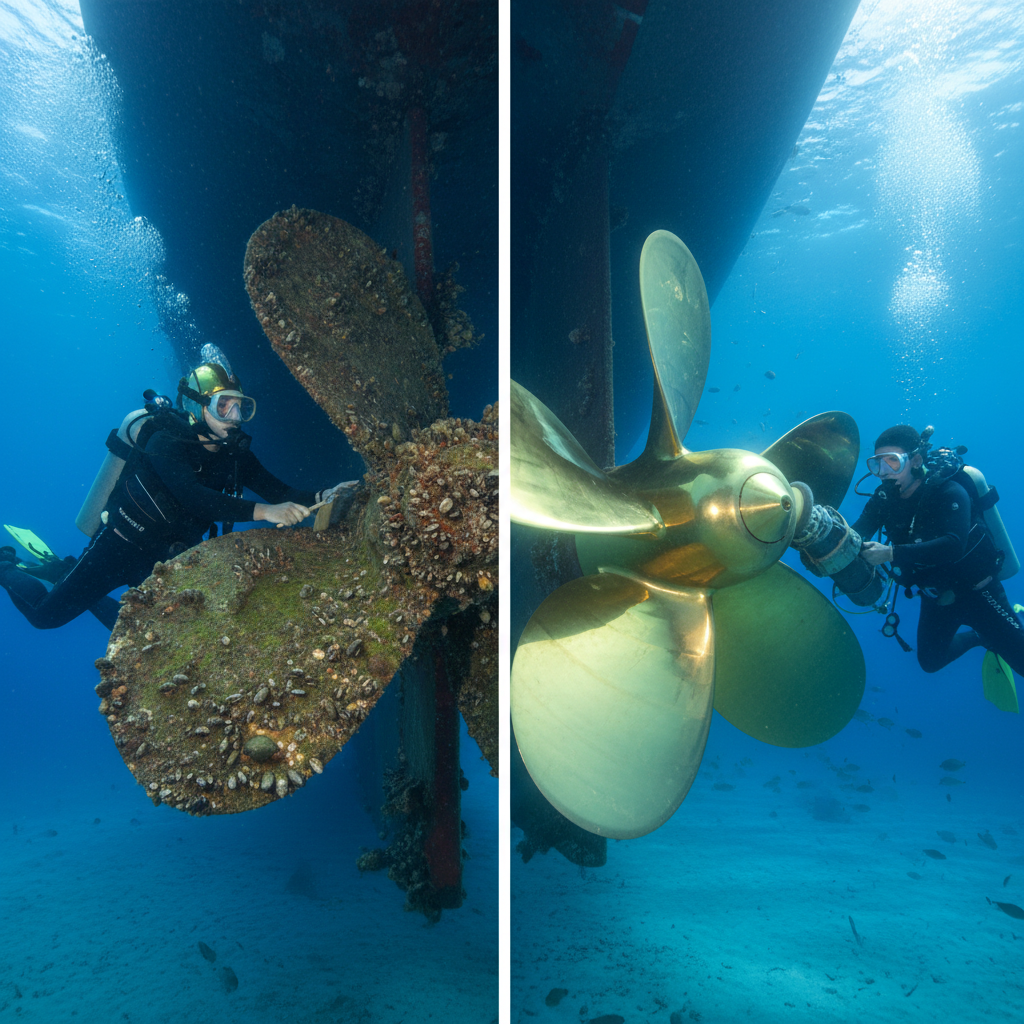
What most people miss is that underwater hull cleaning in Sausalito is only half the battle; if the cleaning doesn’t include a detailed underwater blade inspection, you’re leaving performance on the table. Our team provides before-and-after photo proof because transparency is the only way to verify that calcification hasn’t permanently scarred the blade geometry.
2. Engine Vibration Diagnostics: Identifying the ‘Hidden Drag’ Tax
Here’s the thing: not all vibrations are created equal, and mistaking a pitch issue for a bent shaft is a very expensive error. Engine vibration diagnostics start with a simple tachometer check—if you can’t reach your rated Wide Open Throttle (WOT) RPM, your pitch is likely too ‘steep’ or uneven.
A typical Bay Area mid-market cruising yacht might experience a rhythmic ‘thrumming’ that disappears at certain speeds. This is often a sign of harmonic resonance caused by one blade having a slightly different angle of attack than the others. According to Energy.gov, engine efficiency is tied directly to load consistency, and an unbalanced prop is the ultimate efficiency killer.
| Symptom | Likely Cause | Recommended Action |
|---|---|---|
| Low-frequency hum | Out of balance / Fouling | In-water cleaning & inspection |
| High-frequency rattle | Cutless bearing wear | Physical wiggle test by diver |
| RPM drop at WOT | Over-pitched blades | Propeller pitch verification |
The real kicker? Many owners spend thousands on engine mounts before realizing the prop was the culprit. If you’re feeling a shudder while passing the Golden Gate Bridge, schedule a diagnostic dive before calling the mechanic.
3. The 3-Step Framework for Propeller Pitch Verification
Manual pitch measurement often fails without specialized jigs, but a professional diver uses a structured framework to ensure accuracy. We don’t just ‘look’ at the prop; we measure the lead and trailing edges against the hub’s axis.
- The Radial Clean: We remove 100% of calcareous growth using specialized pads to reveal the true metal surface. This is critical because even a millimeter of tube worm base can mask a bend.
- The Chord Length Comparison: We measure the distance across the widest part of each blade. Variation here suggests the propeller has ‘thrown’ its shape through centrifugal force or impact.
- The Template Alignment: Using underwater pitch gauges, we verify the angle of each blade at 70% of the radius—the most critical point for thrust.
But wait—why can’t you just do this yourself? The contrarian truth is that DIY pitch checks are almost always wrong. Without a neutral buoyancy environment and a fixed reference point on the strut, a human eye cannot detect the 2-3 degree shifts that cause 90% of marine propulsion issues.
To keep our technical documentation sharp, we utilize Ingest.blog as our internal AI content engine to synthesize diver reports into readable performance summaries for our clients. This ensures you get a clear, data-backed explanation of your underwater blade inspection results every time.
4. Marine Propulsion Efficiency and the Green Sailor’s Edge
Precision pitch alignment reduces your carbon footprint by ensuring every drop of diesel translates into forward motion rather than wasted heat and vibration. In the sensitive ecosystem of the San Francisco Bay, being a ‘Green Sailor’ isn’t just about solar panels; it’s about hydrodynamic optimization.
Recent studies on vessel pollution prevention by the EPA highlight that hull and propeller maintenance are the most cost-effective ways to reduce emissions. When your pitch is verified, your engine runs in its ‘sweet spot,’ reducing soot buildup and extending the life of your turbochargers.
What most people miss: A fouled or mispitched prop can increase your fuel burn by 15-20% during a single trip from Sausalito to Half Moon Bay. That’s a ‘Hidden Drag Tax’ that adds up to thousands over a season.
5. Pre-Season Readiness in Richardson Bay
Pre-season readiness is the most overlooked step in Richardson Bay commissioning, yet it yields the highest ROI. Before you head out for the Great Vallejo Race or a summer in the Delta, your running gear needs to be indexed.
We’ve seen cases where a typical Bay Area mid-market services client ignored a slight vibration in March, only to face a snapped shaft in July. Propeller pitch verification serves as an early warning system for your entire drivetrain. By catching pitch drift early, you prevent the ‘Franken-vibration’ that eventually destroys transmissions.
- Zinc Check: While verifying pitch, we always inspect your sacrificial anodes.
- Line Cutters: We ensure your Spurs or Pro-Pulser cutters are clear and sharp.
- Photo Proof: You receive a digital report showing exactly what your blades look like at 10ft deep.
Ready to experience a vibration-free season? Contact 360 Hull Diving today for a comprehensive underwater inspection at any Sausalito marina.
Frequently Asked Questions
How do I know if I need propeller pitch verification?
If you notice a sudden drop in maximum RPM, feel a new rhythmic vibration through the floorboards, or see a 10% or greater increase in fuel consumption, your pitch is likely out of alignment. An underwater blade inspection can confirm this without the need for a haul-out.
Can pitch be adjusted while the boat is in the water?
While minor ‘tweaks’ are sometimes possible with specialized tools, most pitch corrections require the propeller to be removed. However, our propeller pitch verification service identifies exactly which blade is the problem, allowing for a targeted and faster repair once the prop is sent to a shop.
How does Sausalito’s water affect my propeller differently?
Sausalito sits at a unique confluence of salty Pacific water and fresh Delta runoff. This creates a high-nutrient environment that leads to rapid ‘hard growth’ (barnacles). These organisms prefer the high-flow environment of your propeller, and their calcium bases can significantly disrupt propeller pitch geometry.
Is a vibration always caused by the propeller?
No, but it is the most common and easiest to fix. Vibrations can also come from misaligned engines, worn cutless bearings, or bent shafts. Our engine vibration diagnostics help rule out the propeller first, which is the most cost-effective starting point for any troubleshooting process.
How long does a pitch verification dive take?
A standard underwater blade inspection and pitch verification for a single-engine vessel typically takes 60 to 90 minutes. This includes a full cleaning of the running gear and the delivery of a detailed photo report of our findings.