
📋 Table of Contents
- 1. Forensic Analysis: Identifying Underwater Metal Erosion
- 2. The Stabilization Phase: Arresting the Damage
- 3. Hydrodynamic Restoration and Performance Verification
- Why Richmond Marina Requires a Specific Approach
- The Environmental Impact of Proactive Maintenance
- Next Steps: Your Monday Morning Checklist
- FAQs
According to the U.S. Department of Energy, even minor surface roughness on a propeller can lead to a 10-15% increase in fuel consumption due to drag and inefficiency. For powerboat owners at Richmond Marina, this isn’t just a theoretical loss; it is a tangible “hidden tax” paid every time you throttle up to head toward the Golden Gate.
The culprit is often misunderstood: propeller cavitation recovery is not just about cleaning off barnacles, but about arresting a violent physical process where microscopic vacuum bubbles implode against your running gear with enough force to punch holes in solid bronze. If you have noticed a drop in top-end speed or a strange vibration at cruising RPM, your boat is likely suffering from underwater metal erosion that requires immediate intervention.
Key Takeaways for Richmond Boat Owners:
- Identify cavitation early to avoid $5,000+ propeller replacement costs.
- The brackish water transition in Richmond accelerates galvanic corrosion alongside cavitation.
- Our 3-step framework restores hydrodynamic efficiency without the need for a costly haul-out.
- Photo proof is the only way to verify that pitting has been stabilized.
1. Forensic Analysis: Identifying Underwater Metal Erosion
The first step in any successful recovery is distinguishing between simple wear and the aggressive pitting caused by imploding vapor bubbles.
What most people miss is that cavitation often starts at the root of the blade or the tips, areas that are frequently overlooked during a standard “quick scrub.” In the specific environment of Richmond Marina boat maintenance, we see a unique combination of high silt content and varying salinity that can mask the early signs of metal fatigue. When air bubbles collapse against the metal, they create localized pressure waves exceeding 10,000 psi, literally sandblasting the surface from the inside out.
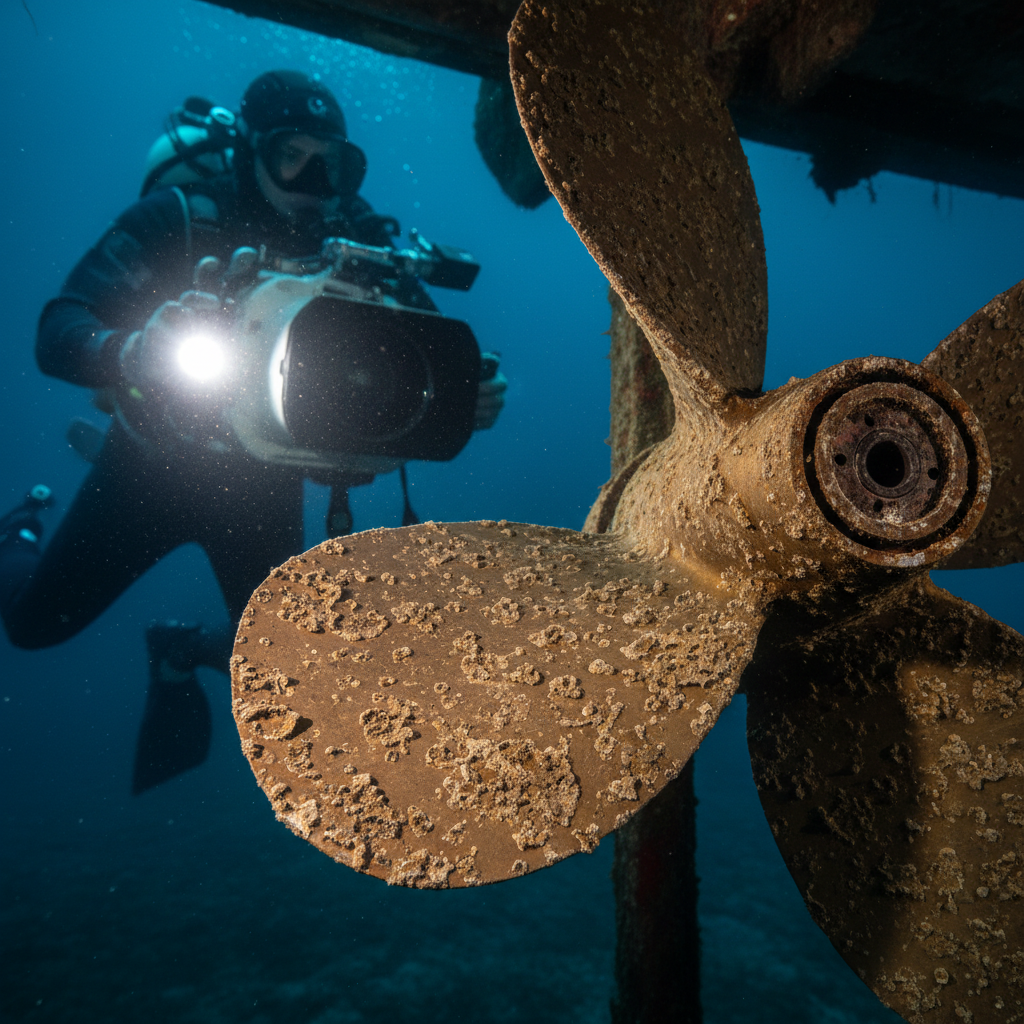
During our forensic phase, we look for:
- Sponge-like Textures: A tell-tale sign that the metal’s structural integrity is failing.
- Burnished Edges: Areas where the metal looks “polished” but is actually thinning rapidly.
- Zonal Pitting: Specific clusters of holes that indicate a flow imbalance in your in-water powerboat maintenance routine.
Here’s the thing: ignoring these signs leads to “singing propellers” and eventually, permanent blade failure. By catching this during a routine dive, a typical Bay Area mid-market recreational vessel owner can save thousands in emergency dry-dock fees. If you’re unsure about your current prop health, you can schedule a professional inspection here.
2. The Stabilization Phase: Arresting the Damage
Stabilization is about more than just cleaning; it’s about neutralizing the environment that allows cavitation to thrive.
The real kicker? Most divers use overly abrasive pads that actually increase surface porosity, creating more sites for bubbles to form. Our approach to propeller cavitation recovery involves a “Zero-Impact” cleaning methodology. We use specialized tools designed to remove calcium deposits without scoring the underlying alloy, which is critical for maintaining the smooth flow required for hydrodynamic efficiency.
| Feature | Traditional Scrubbing | 360 Hull Diving Framework |
|---|---|---|
| Tooling | Steel brushes/heavy pads | Composite non-marring tools | Surface Finish | Rough/Porous | Polished/Hydrodynamic | Zinc Check | Visual only | Electrical continuity testing | Documentation | None/Verbal | Before & After Photo Proof |
But wait—cleaning is only half the battle. In Richmond, the proximity to the San Pablo Bay means your boat deals with brackish water that fluctuates in conductivity. We verify your sacrificial anodes (zincs) because underwater metal erosion is often accelerated by stray current. If your zincs are over 50% depleted, the cavitation pitting will happen twice as fast. We ensure your Richmond Marina boat services include a full zinc audit to protect your investment.
3. Hydrodynamic Restoration and Performance Verification
The final step is ensuring the water flows over your blades as the manufacturer intended, reducing the turbulence that causes cavitation in the first place.
What we’ve found in our work with high-performance powerboat owners is that even a 1mm deviation in blade edge smoothness can trigger cavitation at high RPMs. Once we’ve cleaned and stabilized the metal, we perform a micro-burnishing of the affected areas. This smooths out the “peaks and valleys” of the pits, significantly reducing the nucleation points where vapor bubbles form. This is the core of cavitation repair Richmond CA—preventing the problem from returning next month.
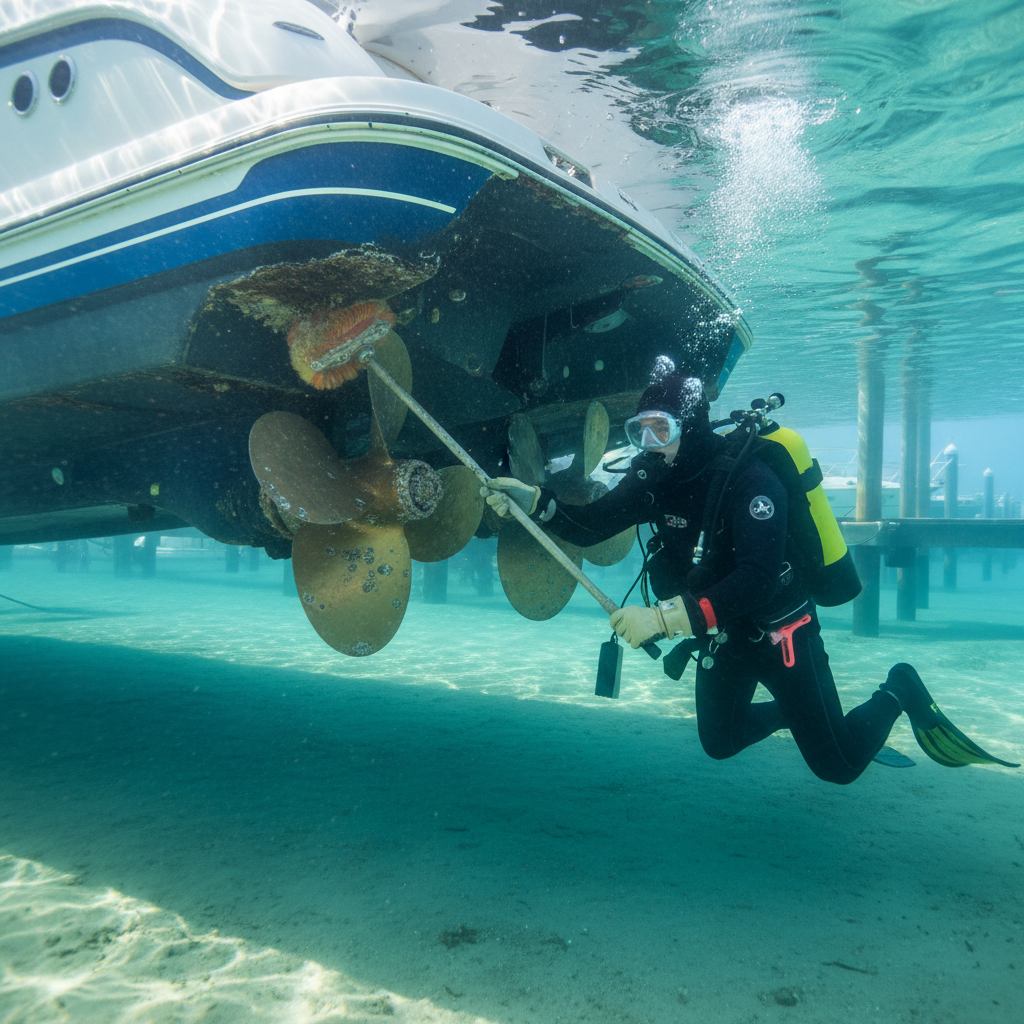
The results are immediate:
- Reduced Vibration: Smoother flow means less stress on your cutlass bearings and transmission.
- RPM Recovery: Many owners see a gain of 50-100 RPM at wide-open throttle (WOT).
- Fuel Savings: By restoring the prop’s grip on the water, you stop wasting energy on “slippage.”
Contrary to popular belief, you don’t always need to pull the boat to fix performance issues. A targeted, in-water propeller cavitation recovery plan is often more effective and significantly faster than a week-long haul-out. To see how we’ve helped other boats in your marina, check out our latest service reports and photos.
Why Richmond Marina Requires a Specific Approach
Richmond isn’t just another stop in the Bay; it’s a high-fouling environment with unique tidal flows that impact how marine growth removal should be handled.
The heavy sediment from the delta acts like an abrasive in the water column. When this sediment gets caught in the low-pressure zones of a cavitating prop, it acts like a liquid grinder. This is why Richmond Marina boat maintenance requires a more frequent schedule than boats kept in the cleaner, saltier waters of Sausalito or Tiburon. We recommend a 4-to-6 week cleaning cycle during the peak summer months to keep the hydrodynamic efficiency at its peak.
Need a hand keeping up with the growth? Our team is at Richmond Marina weekly. Contact 360 Hull Diving today for a transparent quote with no hidden fees.
The Environmental Impact of Proactive Maintenance
Protecting the San Francisco Bay ecosystem is a responsibility every Richmond boater shares, and it starts with how you maintain your hull.
When a propeller is heavily fouled or pitted, the engine has to work harder, burning more fuel and increasing carbon emissions. Furthermore, aggressive cleaning of a neglected hull releases more anti-fouling paint into the water. By using our 3-step framework, you are opting for a “maintenance” approach rather than a “restoration” approach. According to the Environmental Protection Agency (EPA), proactive hull grooming is the most effective way to prevent the spread of invasive species while preserving water quality.
We take pride in our eco-friendly methods. Because we use photo-documentation for every dive, you can see exactly what was removed and the condition of the paint beneath. It’s transparency that benefits both your wallet and the Bay.
Next Steps: Your Monday Morning Checklist
Don’t wait for a mechanical failure to address your boat’s performance. Here is what you can do this week to start the propeller cavitation recovery process:
- Check Your Logs: Compare your fuel burn from last season to your most recent trip. A 10% increase is a red flag.
- Feel the Vibration: Next time you’re out, slowly bring the boat through the RPM range and note any “shudders” in the deck.
- Inspect the Waterline: If you see heavy growth at the waterline, your running gear is likely in worse shape.
- Book a Dive: Get a professional set of eyes (and a camera) under your boat to catch pitting before it becomes a hole.
Ready to restore your powerboat’s performance? At 360 Hull Diving, we provide the Bay Area’s most trusted, insured dive services with the photo proof to back it up. Click here to get your free estimate or call us to discuss your vessel’s specific needs at Richmond Marina.
Frequently Asked Questions
How do I know if my propeller is cavitating or just dirty?
Cavitation usually presents as a distinct vibration at specific high-RPM ranges and may cause a “growling” sound. Visual cues include small, jagged pits in the metal, often near the blade tips. Simple growth usually causes a general sluggishness across all speeds without the sharp vibration or metal loss associated with cavitation.
Can propeller cavitation recovery be done entirely underwater?
Yes, for most recreational powerboats, stabilization and micro-burnishing can be performed by a skilled diver. This arrests the underwater metal erosion and restores efficiency. However, if the blades are bent or the metal loss exceeds 20% of the blade thickness, a haul-out for shop reconditioning may be necessary.
How much fuel can I really save with a clean propeller?
Industry data and our own observations at Richmond Marina suggest that a clean, smooth propeller can improve fuel economy by 5% to 15% compared to a fouled or pitted one. Over a season of cruising the San Francisco Bay, this often pays for the cost of the dive service itself.
Does Richmond Marina’s water affect my boat differently?
Absolutely. Richmond sits at a junction of salt and fresh water. This brackish environment is highly corrosive and promotes a specific type of hard-shell growth that is difficult to remove without the right tools. Regular Richmond Marina boat maintenance is essential to prevent these elements from permanently damaging your running gear.