
📋 Table of Contents
By 2026, a single millimeter of slime on your hull will spike your fuel consumption by up to 21%, effectively flushing thousands of dollars into the San Francisco Bay every season. If you are still waiting for ‘visible growth’ before calling a diver, you aren’t just behind the curve—you are actively destroying your boat’s most expensive asset: its bottom paint.
The landscape of marine services / underwater hull maintenance is undergoing a radical transformation. We are moving away from the era of ‘reactive scrubbing’ and entering the age of ‘proactive grooming.’ For owners at the St. Francis Yacht Club or South Beach Harbor, understanding this shift is the difference between a high-performance vessel and a floating science experiment that costs a fortune to remediate.
The Death of Scrubbing: 2026 Marine Services / Underwater Hull Maintenance Trends
The most expensive mistake a boat owner can make in 2026 is treating their hull like a kitchen floor that needs a hard scrub once a month. As of 2026, the industry has pivoted toward high-frequency, low-impact grooming that preserves the integrity of expensive specialized coatings.
What most people miss: Traditional abrasive cleaning methods can remove up to 10% of your anti-fouling paint in a single session. This creates a vicious cycle where the paint thins, growth attaches faster, and you need more aggressive cleaning. Modern proactive hull grooming focuses on removing micro-fouling (slime) before it transitions into macro-fouling (barnacles and tubeworms).
- Preservation of Micron Thickness: Grooming uses soft materials to wipe away biofilm without depleting the biocide layers.
- CII Rating Optimization: Even for recreational vessels, maintaining a smooth hull is becoming a standard for resale value and fuel efficiency.
- Hydrodynamic Hull Performance: A groomed hull maintains the laminar flow intended by the naval architect, keeping your top speed where it belongs.
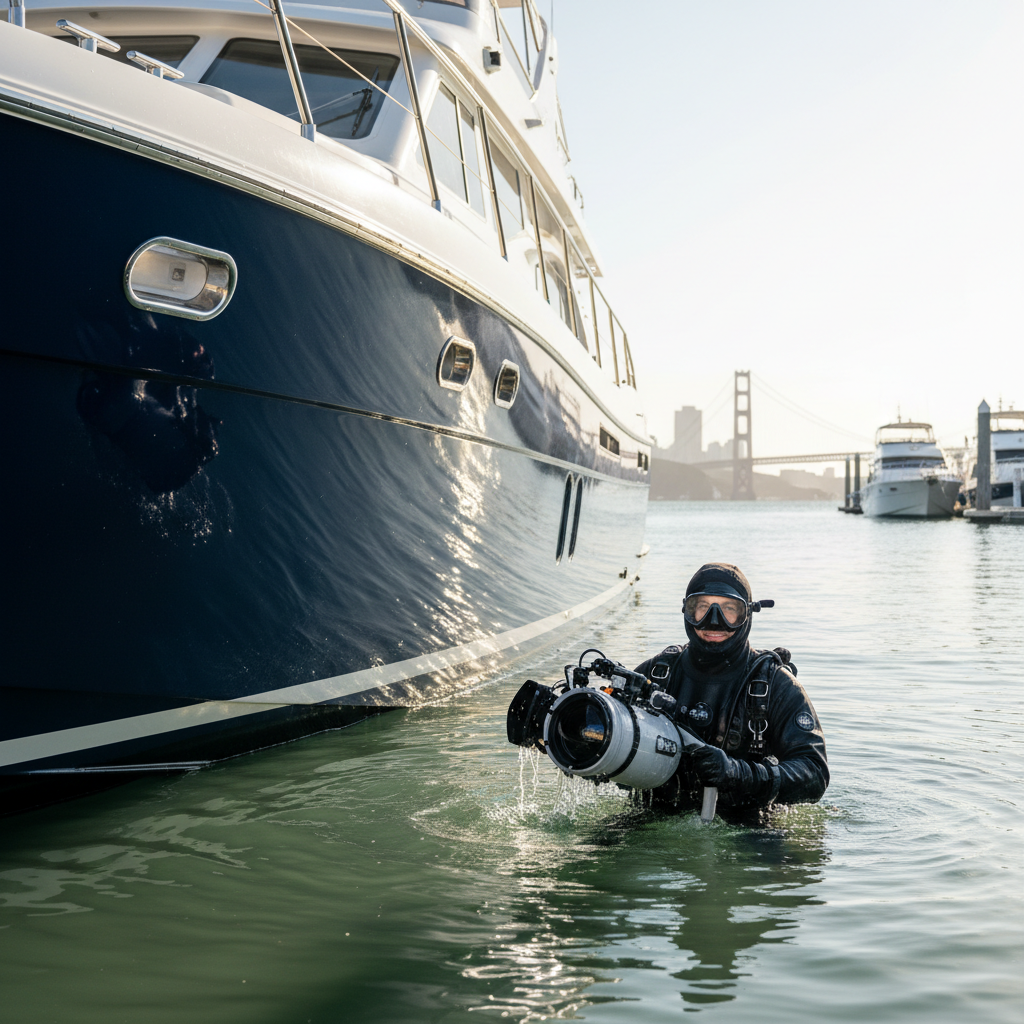
Regulatory Readiness and the Biofouling Management Plan
Local port authorities in the Bay Area are rapidly moving toward mandatory debris capture for all in-water cleaning activities to protect our local ecosystems. The days of ‘cleaning and letting the debris fall’ are numbered as the EPA and local water boards tighten restrictions on heavy metal discharge.
The real kicker? In 2026, having a documented biofouling management plan isn’t just for commercial tankers; it’s becoming the gold standard for high-end yacht management. One of our clients, a CEO with a 55-foot cruiser in Sausalito, was recently denied entry to a premium marina in Southern California because he couldn’t provide proof of a consistent, eco-friendly maintenance log. We solved this by providing him with our signature before-and-after photo proof for every service.
Key regulatory elements for 2026 include:
- Mandatory Debris Recovery: Systems that vacuum and filter the discharge during the cleaning process.
- Transition to Biocide-Free Coatings: The shift toward silicone-based foul release coatings that require specialized, non-abrasive care.
- In-Water Inspection Standards: Using high-definition video to verify hull condition without hauling the boat.
Need to ensure your vessel stays compliant and efficient? Schedule your 2026 maintenance consultation with 360 Hull Diving today.
The ROI of Proactive Grooming vs. Reactive Scrubbing
Contrary to popular belief, spending $150 a month on frequent grooming is significantly cheaper than spending $1,200 on a heavy-duty scrape and a premature $10,000 haul-out for new bottom paint. In 2026, marine services / underwater hull maintenance best practices dictate that maintenance is a fuel hedge, not just a cosmetic chore.
Consider this data comparison for a standard 40-foot sailboat in Richmond or Alameda:
| Feature | Reactive Scrubbing (Old Way) | Proactive Grooming (2026 Standard) |
|---|---|---|
| Cleaning Frequency | Every 3-4 Months | Every 3-4 Weeks |
| Paint Lifespan | 1.5 – 2 Years | 3.5 – 5 Years |
| Fuel Efficiency Loss | 15% – 25% Average | < 2% Average |
| Environmental Impact | High (Heavy Metal Release) | Low (Biofilm Removal Only) |
The math is undeniable. A client at Berkeley Marina found that by switching to our proactive schedule, they saved $1,400 in fuel costs over 12 months, which completely covered the cost of their marine services / underwater hull maintenance for the entire year.
Advanced Marine Services / Underwater Hull Maintenance Best Practices
Effective maintenance in 2026 requires a deep understanding of the specific galvanic environment of your marina. What works in the brackish waters of Petaluma will fail miserably in the high-salinity environment of the Tiburon Peninsula.
Here is the 2026 checklist for superior hull health:
- Zinc & Galvanic Protection: Don’t just check if the zinc is there; measure the rate of decay. Rapid loss indicates a stray current issue in your marina.
- Propeller & Running Gear: Use biocide-free foul release coatings like Propspeed, which require delicate cleaning to avoid ruining the expensive finish.
- Intake Grates & Bow Thrusters: These are often neglected but are the first places to clog, leading to engine overheating or thruster failure.
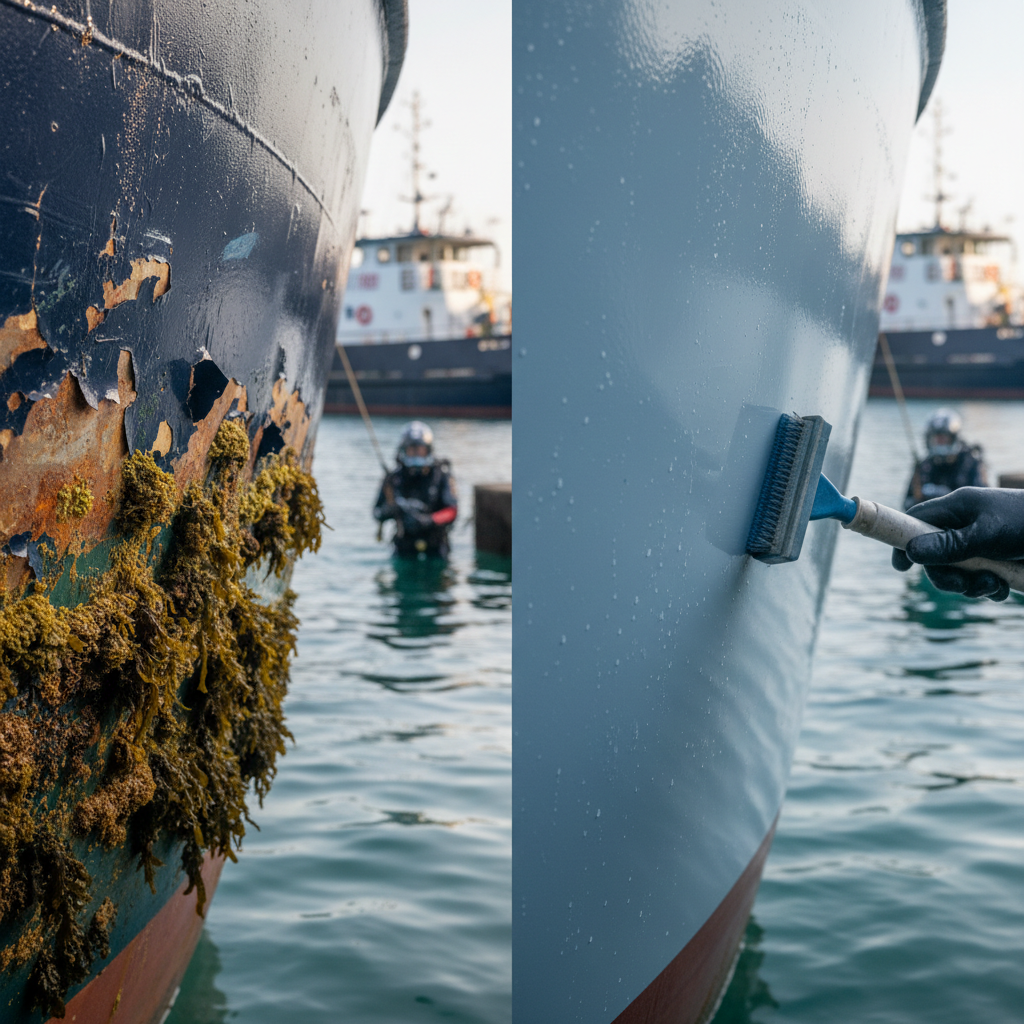
But wait—what most divers won’t tell you is that over-cleaning can be just as bad as under-cleaning. If your diver is using a stainless steel brush on your soft ablative paint every month, they are literally brushing your money into the water. At 360 Hull Diving, we use the softest possible tool for the job, backed by photographic evidence that we’ve preserved your coating.
Ready for a smarter approach to boat care? Check out our guide on corrosion protection to see how we keep Bay Area boats in peak condition.
The Rise of Ultrasonic and Silicone Technologies
We are seeing a massive surge in the integration of ultrasonic anti-fouling systems. These systems use high-frequency transducers to create microscopic bubbles that burst, preventing larvae from attaching. However, these are not “install and forget” solutions.
The reality is that ultrasonic systems only work on the hull’s hard surfaces; they don’t protect your running gear or through-hulls effectively. In 2026, the best strategy is a hybrid approach: ultrasonic systems combined with professional marine services / underwater hull maintenance to handle the shadows and niches the sound waves can’t reach.
- Silicone Foul Release: These coatings make the hull so slippery that growth falls off when the boat moves at speed.
- Robotic Inspections: We now use ROVs (Remotely Operated Vehicles) for deep-water inspections in San Francisco Bay to identify issues before they become emergencies.
- Digital Twin Modeling: High-end management firms are now using hull data to predict exactly when a boat will lose its hydrodynamic edge.
Why Transparency is the New Standard in 2026
The era of ‘trust me, it’s clean’ is over. Sophisticated boat owners now demand—and deserve—visual proof of the work performed under the waterline. Transparency is the cornerstone of modern marine services / underwater hull maintenance.
At 360 Hull Diving, we provide high-resolution before-and-after photos for every single dive. This isn’t just for your peace of mind; it’s a critical part of your boat’s maintenance record for insurance and resale. If a service provider can’t show you what they did, did they really do it? In the murky waters of the Bay, you need a team that brings the clarity to you.
Whether you are docked in Emeryville, Oakland, or San Francisco, your boat deserves a level of care that matches the investment you’ve made. Don’t settle for ‘good enough’ when it comes to the part of your boat that actually touches the water.
Stop guessing about your hull’s condition. Contact 360 Hull Diving now to schedule your first 2026-standard grooming session and experience the difference of data-backed maintenance.
FAQs
How often does a boat need marine services / underwater hull maintenance in 2026?
In the high-growth environment of the San Francisco Bay, we recommend a 3-to-4-week interval. This allows for proactive grooming of the biofilm (slime) before hard growth attaches. This frequency preserves your bottom paint and ensures maximum fuel efficiency, which is a core 2026 best practice.
What is the difference between hull scrubbing and hull grooming?
Hull scrubbing is a reactive process using abrasive tools to remove established growth, which often damages the paint. Hull grooming is a proactive, gentle cleaning that removes slime before barnacles can form, extending the life of your anti-fouling coating by up to 50%.
Are silicone-based coatings better for Bay Area boats?
Silicone foul-release coatings are excellent for boats that move frequently at high speeds, as they allow growth to shed naturally. However, they require specialized, non-abrasive marine services to maintain. For boats that sit for long periods, traditional high-quality ablative paints may still be preferred.
Do I really need photos of my hull cleaning?
Yes. In 2026, photo documentation is vital for insurance claims, resale value, and verifying that your running gear and intakes are clear. It ensures transparency and holds your dive team accountable for the quality of their underwater hull maintenance work.