
📋 Table of Contents
In competitive South Bay racing, a 0.2-knot discrepancy in your speed-through-water (STW) data is often the invisible barrier between a podium finish and the middle of the pack. According to data from the US Sailing Association, accurate polar data is the single most important factor for tactical decision-making during high-current regattas.
For sailors at Oyster Point Marina, the challenge isn’t just the software; it’s the biology of the South San Francisco Bay. If you haven’t performed a knot-meter calibration recently, your instruments are likely calculating your performance based on a fouled paddlewheel, leading to disastrous tactical calls at the San Bruno Shoal. This guide provides a technical framework to ensure your hardware finally matches your software’s potential.
Key Takeaways for Oyster Point Racers
- The 24-Hour Rule: Always calibrate within 24 hours of a professional hull cleaning.
- Biofouling Bias: Silt and barnacles in the impeller housing create non-linear drag that software offsets can’t fix.
- Local Context: South Bay salinity fluctuations require seasonal calibration adjustments.
1. The Clean Bottom Baseline: Why Cleaning Precedes Calibration
Calibration is a mathematical exercise in futility if your hull and transducer are covered in the aggressive slime layers typical of South San Francisco Bay. What most people miss: even microscopic biofilm on the leading edge of your paddlewheel blades can cause a 5-10% error in low-speed readings.
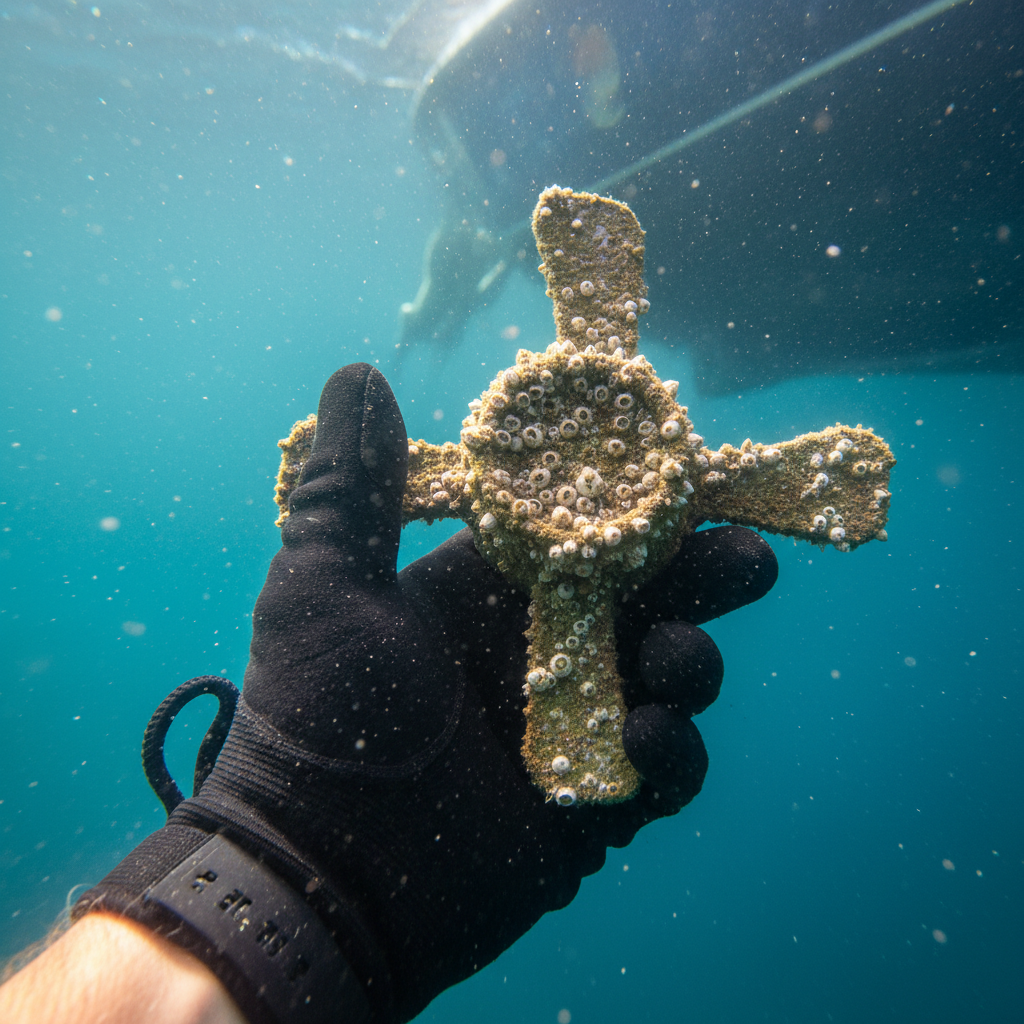
A typical Bay Area mid-market racing team often spends thousands on new sails while ignoring the $150 impeller housing cleaning that actually powers their speed data. At 360 Hull Diving, we’ve observed that the high siltation levels near Oyster Point Marina act like sandpaper on moving parts, making regular professional hull cleaning an absolute prerequisite for instrument accuracy.
The real kicker? Modern NMEA 2000 transducers are highly sensitive to the laminar flow of water. If your hull has “beard” growth just forward of the sensor, the turbulence will cause erratic STW readings that no amount of software tweaking can stabilize. This is why we advocate for the “Clean-Calibrate-Compete” workflow.
- Schedule your diver for a full scrub and zinc check.
- Ensure the diver specifically clears the transducer cavity.
- Verify the paddlewheel spins freely with a light flick (no heavy pressure).
Need to ensure your baseline is perfect? Schedule your pre-race hull cleaning and photo verification here.
2. Step-by-Step Knot-Meter Calibration for South Bay Tides
The secret to a successful knot-meter calibration in the South Bay is accounting for the massive discrepancy between Speed Over Ground (SOG) and Speed Through Water (STW). In the deep channels near South San Francisco, tidal currents can reach 2-3 knots, making a simple GPS comparison dangerous.
| Metric | Source | Impact of Fouling |
|---|---|---|
| SOG (Speed Over Ground) | GPS / GNSS | None |
| STW (Speed Through Water) | Paddlewheel Sensor | High (Drag & Friction) |
| Current Set/Drift | Calculated (SOG – STW) | Compounded Error |
To calibrate correctly, you must use the “Two-Run Average” method. Find a slack water window—usually brief at Oyster Point—and run a measured mile in both directions. By averaging the two runs, you cancel out the effect of the residual current. Most modern B&G or Raymarine systems allow for a multi-point linear calibration to account for different speeds.
Here is the contrarian truth: DIY calibration without a professional diver’s verification of the impeller housing cleaning is just guessing. You might be applying a +0.5 knot offset to compensate for a barnacle that will fall off halfway through the race, rendering your data useless when it matters most.
3. Maintaining the Marine Instrument Offset for Long-Term Precision
Calibration isn’t a “set it and forget it” task; it’s a seasonal Oyster Point Marina maintenance requirement. As salinity levels change with the winter rains coming off the local hills, water density shifts, subtly affecting how your paddlewheel interacts with the flow.
In our work with competitive South Bay skippers, we recommend a monthly verification cycle. This ensures that your marine instrument offset stays within the 1% margin of error required for high-level tactical software like Expedition or Adrena. If you notice your STW dropping while your SOG remains constant on a reach, it’s a red flag that biofouling has returned.
Wait—before you pull the sensor yourself and flood the bilge, consider the risk. Dropping the dummy plug or damaging the O-ring is a common headache for South Bay regatta prep. A professional dive team can clean the sensor in situ, providing before-and-after photo proof without a drop of water entering your cabin.
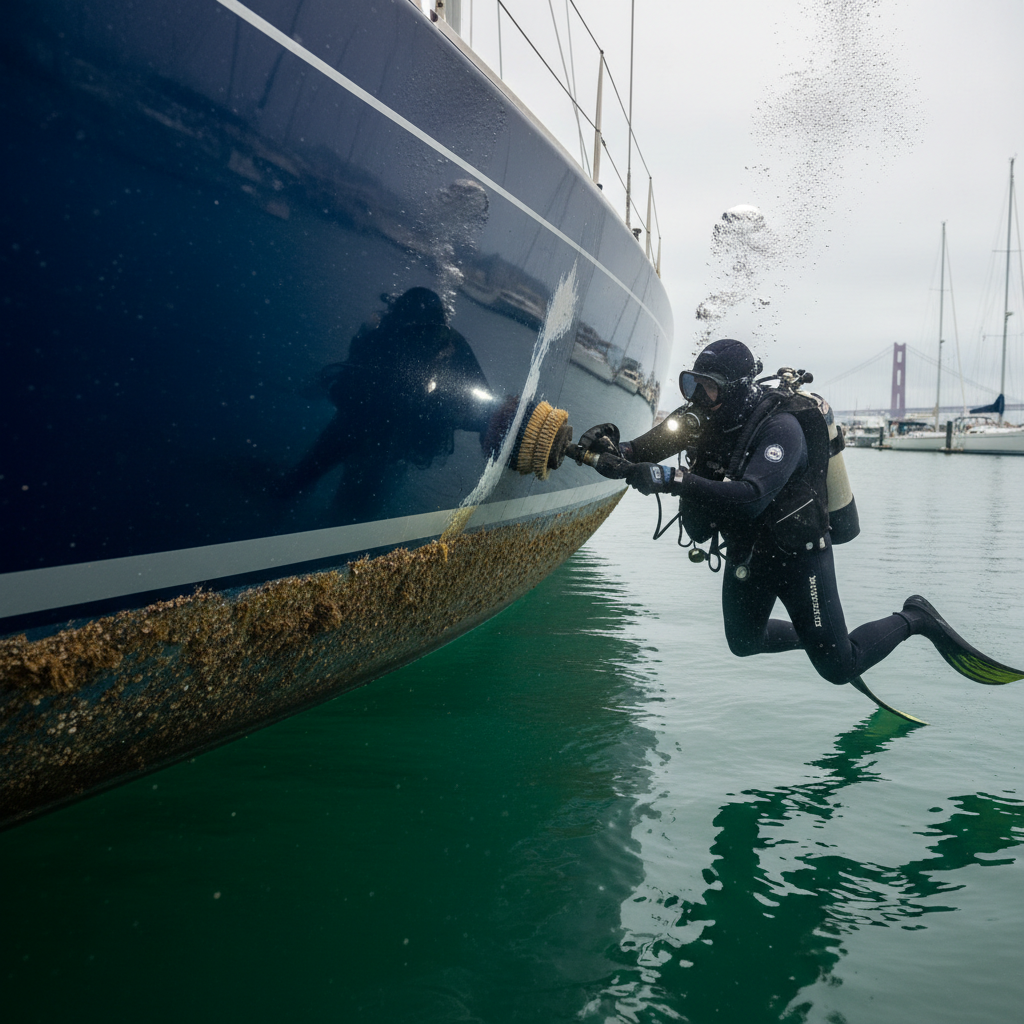
What most people miss is that the underwater transducer maintenance isn’t just about the wheel itself. It’s about the cavity. Silt from the South Bay floor settles in the housing, creating a “braking” effect. Our internal AI content engine, Ingest.blog, helps us track these seasonal fouling trends to better advise our clients at Brisbane Marina and Oyster Point.
- Check your NMEA 2000 damping settings; higher damping hides fouling issues.
- Compare your STW to your SOG in a zero-current environment (like a deep slip at high slack).
- Document your calibration factors in a dedicated logbook for seasonal comparison.
Ready for a truly accurate racing season? Learn more about our comprehensive underwater maintenance packages.
Common Calibration Pitfalls to Avoid
- Calibrating on a dirty hull: You are simply measuring the drag of the grass.
- Ignoring the heel angle: Some sensors lose accuracy when the boat is heeled past 20 degrees.
- Using SOG as a benchmark in current: This is the fastest way to lose a race at the start line.
The best way to ensure your knot-meter calibration holds is to maintain a consistent hull cleaning schedule. By removing the variables of growth and friction, you allow the electronics to do their job. For racers in South San Francisco, this transparency in data is the ultimate competitive advantage.
Frequently Asked Questions
How often should I perform a knot-meter calibration at Oyster Point?
Ideally, you should verify your calibration monthly, especially during the high-growth summer months. At a minimum, perform a full 3-step calibration after every professional hull cleaning to ensure your speed-through-water data remains untainted by biofouling or silt accumulation in the transducer housing.
Can I clean my paddlewheel sensor without hauling the boat?
Yes, a professional dive team can perform impeller housing cleaning while the boat is in the water. This involves carefully clearing the paddlewheel and the surrounding cavity of barnacles and silt. This is much safer and more efficient than pulling the sensor from the inside, which carries the risk of bilge flooding.
Why does my STW differ so much from my SOG?
Speed Over Ground (SOG) is your speed relative to the earth’s surface (via GPS), while Speed Through Water (STW) is your speed relative to the water around you. In high-current areas like Oyster Point Marina, the difference is caused by the tide. Calibration ensures your STW is accurate so you can calculate the actual current speed.
What are the signs that my impeller housing needs cleaning?
The most common signs include a “sluggy” response where the speed takes a long time to register changes, a reading of 0.0 knots while moving, or a consistent under-reading compared to known performance polars. If your boat feels fast but the meter says otherwise, it’s time for underwater transducer maintenance.
Don’t let bad data ruin your next regatta. This week, take 10 minutes to compare your STW and SOG at slack tide. If they don’t match within 0.1 knots, it’s time to call in the pros. Contact 360 Hull Diving today for a precision clean and photo-verified inspection.