
📋 Table of Contents
The Hidden Cost of the Sausalito Slime Factor
Maintaining peak performance for your vessel requires more than just engine tuning; it demands a deep understanding of the local environment. Professional hull cleaning Sausalito services are becoming increasingly critical as Richardson Bay marine growth reaches record levels due to rising water temperatures. For recreational boat owners at Clippership or Schoonmaker Point, the ‘Sausalito Slime’ is not just an aesthetic nuisance—it is a direct tax on your wallet.
Recent data from the San Francisco Estuary Partnership indicates that nutrient-rich runoff in Richardson Bay creates a perfect incubator for aggressive biofilms. Consequently, even a thin layer of slime can increase your hull’s drag coefficient by up to 20% before a single barnacle even attaches. This laminar drag forces your engines to work harder, directly impacting your boat fuel efficiency and long-term engine health.
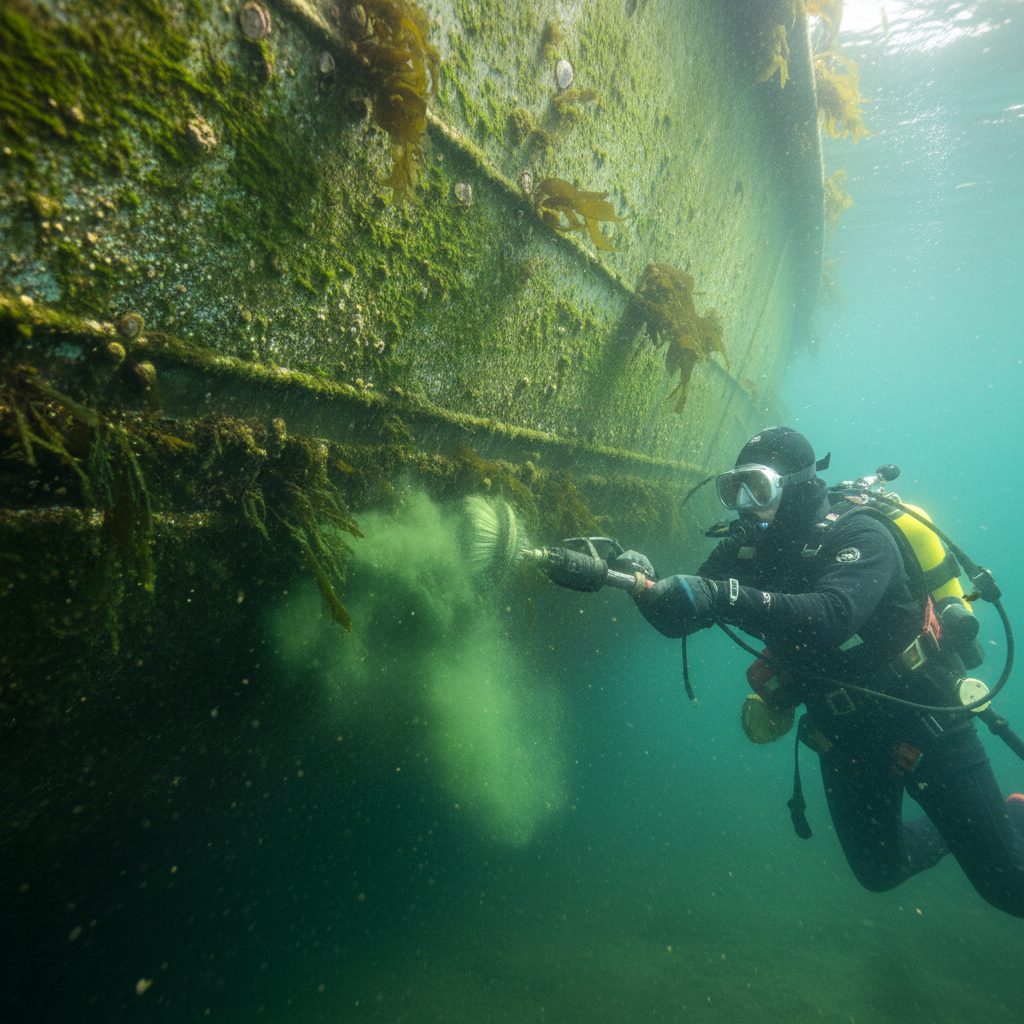
Why Richardson Bay is a Biofouling Hotspot
- Brackish Water Dynamics: The mixing of fresh water from local runoff with salty Bay water creates a high-nutrient environment where microorganisms thrive.
- Temperature Spikes: Higher-than-average water temperatures in 2024 have accelerated the metabolic rate of local marine life, leading to faster fouling cycles.
- Stagnant Pockets: Many marinas in the Sausalito area experience lower tidal flushing, allowing Richardson Bay marine growth to establish itself within 48 hours of a cleaning.
The Science of Slime: How Biofilm Destroys Boat Fuel Efficiency
Many owners wait until they see hard growth like barnacles or tube worms before calling a diver. However, the ‘soft growth’ phase is actually the most deceptive thief of your vessel’s performance. Furthermore, as biofilm thickens, it creates a rough texture that disrupts the smooth flow of water around your hull, known as the biofilm fuel penalty.
Strategic maintenance is the only way to combat this invisible drag. By the time you notice a loss of 2-3 knots at your usual cruise RPM, you have likely been overspending on fuel for weeks. This is why regular hull maintenance is an investment that pays for itself in reduced pump prices.
The Drag Coefficient Breakdown
- Stage 1 (Biofilm): A microscopic slime layer that increases drag by 10-15%.
- Stage 2 (Weed/Grass): Visible green growth that can increase fuel consumption by 20-30%.
- Stage 3 (Hard Growth): Barnacles and calcareous growth that can cause over 50% loss in efficiency and potential engine overheating.
| Fouling Level | Est. Speed Loss (Knots) | Est. Fuel Increase (%) | Action Required |
|---|---|---|---|
| Light Slime | 0.5 – 1.0 | 8 – 12% | Monthly Wipe |
| Heavy Slime / Grass | 1.5 – 3.0 | 15 – 25% | Full Scrub |
| Hard Growth | 3.0+ | 30 – 50% | Heavy Scraping |
Maximizing ROI with Hull Cleaning in Sausalito
Choosing the right partner for hull cleaning Sausalito means looking for more than just a diver with a brush. Because the waters around Marin County are sensitive, using eco-friendly cleaning techniques is vital for both the environment and your bottom paint performance. Advanced divers now use photo-documentation to prove the efficacy of their work, ensuring you see exactly what was removed from your running gear.
Moreover, proactive cleaning preserves your expensive copper-based bottom paint. When growth is allowed to harden, removing it often takes layers of paint with it, leading to premature haul-outs. In contrast, a gentle monthly cleaning schedule keeps the surface smooth and extends the life of your anti-fouling coating significantly.
The 360 Hull Diving Advantage
- Before-and-After Photos: We provide high-resolution visual proof of every cleaning, focusing on props, shafts, and intakes.
- Zinc Monitoring: We check your sacrificial anodes during every dive to prevent costly electrolysis damage.
- Detailed Reports: Receive a digital condition report after every service at marinas like Marina Plaza or Pelican Harbor.
Environmental Impact and California Regulations
Navigating the complex landscape of California’s environmental laws is essential for modern boaters. Organizations like The California State Water Resources Control Board have strict guidelines regarding the release of copper into the Bay. Consequently, specialized underwater hull cleaning SF Bay teams must utilize ‘best management practices’ to minimize plume discharge.
Transitioning to a frequent, soft-cleaning cycle is the most eco-friendly way to maintain a boat in Sausalito. By removing Richardson Bay marine growth while it is still in the ‘slime’ phase, we avoid the aggressive scrubbing that releases heavy metals into the ecosystem. This approach keeps your hull fast and the Bay clean.
Key Environmental Considerations
- In-Water Cleaning Standards: Ensuring your diver follows the latest Port of San Francisco and Sausalito marina regulations.
- Invasive Species Control: Preventing the spread of non-native species that hitchhike on fouled hulls.
- Paint Longevity: Reducing the frequency of hull stripping and repainting to lower your boat’s total carbon footprint.
Propeller and Running Gear: The Critical 5%
While the hull surface area is large, your running gear is where the most significant boat fuel efficiency gains are found. Even a few small barnacles on a propeller can cause cavitation, vibration, and a massive drop in thrust. Therefore, our hull cleaning Sausalito service pays special attention to the ‘business end’ of your boat.
Interestingly, the high-speed rotation of a propeller does not prevent growth in Richardson Bay. In fact, the localized heat generated by moving parts can sometimes accelerate certain types of mineral scaling. Regular propeller polishing ensures that every gallon of fuel is converted into maximum forward motion.
Signs Your Running Gear is Fouled
- Unusual Vibrations: Often caused by asymmetrical growth on propeller blades.
- Increased Engine Temp: Growth in raw water intakes restricts cooling flow.
- RPM Drop: The engine cannot reach wide-open throttle (WOT) due to massive drag.
Conclusion: Stop Paying the Sausalito Slime Tax
Ultimately, the cost of a monthly diver is a fraction of the extra fuel and maintenance costs associated with a fouled hull. By prioritizing hull cleaning Sausalito, you ensure your vessel is always ready for a sunset cruise to Angel Island or a run under the Golden Gate Bridge. Don’t let Richardson Bay marine growth anchor your performance; choose a transparent, tech-forward cleaning partner today.
Frequently Asked Questions
How often should I get hull cleaning in Sausalito?
Given the high nutrient levels in Richardson Bay, we recommend a cleaning every 3-4 weeks. This frequency prevents biofilm from hardening into barnacles, maintaining your boat fuel efficiency and protecting your bottom paint from aggressive scrubbing. Vessels that sit idle for longer periods may require more frequent attention during the summer growth spikes.
Can I see the results of my hull cleaning?
Yes, at 360 Hull Diving, we provide before-and-after photo proof with every service. This transparency ensures you know exactly what the condition of your hull, zincs, and running gear looks like without ever getting wet. It is the best way to track the performance of your bottom paint over time.
Does marine growth really affect fuel economy that much?
Absolutely. Studies by the U.S. Navy and marine researchers show that even heavy slime can increase fuel consumption by up to 20%. In Sausalito’s brackish water, this growth happens rapidly. Regular hull cleaning Sausalito ensures you aren’t wasting hundreds of dollars in fuel due to preventable underwater drag.
What makes Richardson Bay growth different from the rest of the SF Bay?
Richardson Bay is shallower and warmer with more nutrient runoff than the Central Bay. This combination creates a ‘perfect storm’ for Richardson Bay marine growth. Boats docked here typically foul 30-50% faster than those in cooler, deeper water marinas like those in San Francisco or Richmond.