
📋 Table of Contents
- The 4-Point Pitting Inspection: Why Sausalito Marine Maintenance is Changing
- Identifying Aggressive Hull Pitting Identification in Richardson Bay
- Sausalito Marine Maintenance: The Stray Current Factor
- The Steel vs. Aluminum Paradox in Brackish Water
- Predictive Maintenance: Using 4-Point Data to Save Your Hull
- Why DIY Inspection is a High-Risk Gamble
- FAQs
According to the American Boat and Yacht Council (ABYC), stray current leakage in high-density marinas can degrade a sacrificial anode in weeks rather than months, leaving your hull’s structural integrity at immediate risk. If you are moored in Richardson Bay or a busy Sausalito slip, your boat might be acting as the ‘ground’ for a neighbor’s faulty wiring, leading to a rapid electrolytic corrosion inspection need.
Key Takeaways for Bay Area Owners:
- Identify the difference between surface oxidation and deep electrolytic pitting.
- Understand why Sausalito’s brackish water accelerates metal loss.
- Learn the 4-point framework for assessing hull health without hauling out.
- Discover why photo-documented inspections are now an insurance requirement for many steel vessels.
The 4-Point Pitting Inspection: Why Sausalito Marine Maintenance is Changing
The real kicker is that most boat owners confuse standard galvanic corrosion with the much more aggressive electrolytic variety caused by stray current. While galvanic corrosion is a slow dance between dissimilar metals, electrolytic corrosion is a high-speed heist fueled by external electrical leaks from aging marina pedestals or faulty shore power chargers.
In our work with recreational boat owners at Richardson Bay marinas, we’ve seen steel hulls lose 20% of their plate thickness in a single season due to undetected ‘hot’ slips. This isn’t just a maintenance headache; it’s a financial liability. As of 2024, marine underwriters are increasingly requiring documented hull pitting identification reports before renewing policies on vintage steel houseboats and aluminum cruisers.
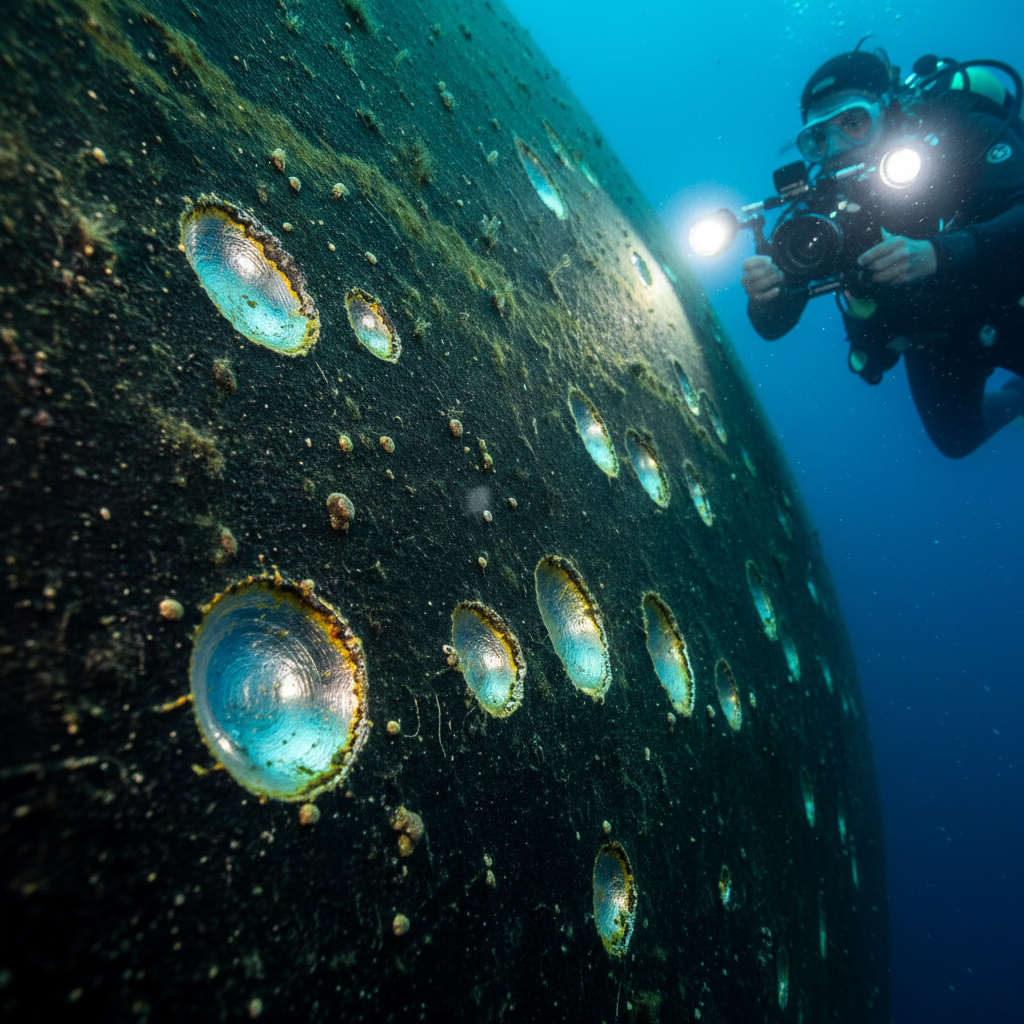
1. Visual Mapping and Crater Morphology
The first point of our inspection focuses on the physical shape of the damage. Electrolytic pitting typically presents as sharp, deep ‘craters’ with bright metal at the bottom, whereas standard oxidation is more uniform and dull. We use high-definition underwater photography to map these sites, providing the ‘before-and-after’ proof that defines the 360 Hull Diving standard.
2. Anode Depletion Rate Analysis
What most people miss is that your zincs (or aluminum anodes) are the ‘canary in the coal mine.’ If you find yourself replacing anodes every three months in a Sausalito marina, you don’t just have a ‘thirsty’ boat; you likely have a stray current issue that requires a professional stray current analysis.
Identifying Aggressive Hull Pitting Identification in Richardson Bay
The brackish transition zone of Richardson Bay creates a unique electrochemical environment where salinity fluctuations can spike corrosion rates overnight. Because fresh water and salt water meet here, the conductivity of the water changes, often rendering traditional sacrificial anode setups inadequate.
Here’s the thing: steel and aluminum react differently to these stressors. In a typical Bay Area mid-market scenario, an aluminum hull might show ‘white powder’ (aluminum oxide) which masks the deep pitting occurring beneath the surface. Steel hulls, conversely, will shed large flakes of rust, often hiding the pinpoint electrolytic holes that lead to localized thinning. This makes professional electrolytic corrosion inspection vital for early detection.
- Steel Hulls: Look for ‘bleeding’ rust spots that reappear days after a cleaning.
- Aluminum Hulls: Check for localized blistering around through-hulls and drives.
- The ‘Hidden Battery’ Effect: Your boat can be damaged by a neighbor’s poorly grounded boat even if your own systems are perfect.
Need a professional eyes-on report? Schedule your 4-point inspection today to get photo-documented proof of your hull’s condition.
Sausalito Marine Maintenance: The Stray Current Factor
The aging infrastructure in many Bay Area marinas means that stray current is a constant threat to docked vessels. According to the EPA’s guidelines on marina best practices, improper shore power grounding is the leading cause of accelerated underwater metal loss.
But wait—simply adding more zinc isn’t the solution. In fact, over-zincing an aluminum hull can actually lead to ‘alkaline pitting,’ a contrarian insight that many DIY boaters learn the hard way. It’s about balance, not volume. We recommend galvanic isolation testing to ensure your boat isn’t sharing electrical loads with the entire dock.
| Feature | Galvanic Corrosion | Electrolytic Corrosion |
|---|---|---|
| Source | Dissimilar metals in water | External electrical leak (Stray Current) |
| Speed | Slow (Months/Years) | Rapid (Days/Weeks) | Uniform surface wasting | Deep, localized ‘drill-bit’ pitting |
The Steel vs. Aluminum Paradox in Brackish Water
Aluminum is more reactive than steel, but in the low-oxygen mud of some Sausalito mooring areas, steel can suffer from ‘anaerobic corrosion’ that mimics electrolytic damage. Identifying the root cause requires more than just a quick scrub; it requires a systematic electrolytic corrosion inspection that looks at the surrounding environment.
What we often see with a typical Bay Area mid-market client is a tendency to rely on ‘eco-friendly’ hull coatings. While great for the environment, some of these coatings can actually mask early-stage pitting by bridging over small craters. Our divers are trained to look for these ‘ghost pits’ that indicate structural thinning is happening beneath the paint layer.
Predictive Maintenance: Using 4-Point Data to Save Your Hull
The real value of a 4-point inspection isn’t just finding damage—it’s predicting the remaining lifespan of your hull plates. By measuring the depth of the deepest pits using a specialized hull pitting depth gauge, we can provide data that helps you plan for your next haul-out with precision rather than guesswork.
- Measure pit depth relative to original plate thickness.
- Assess anode health and consumption rates.
- Inspect running gear (props/shafts) for pinking or dezincification.
- Verify the integrity of through-hull bondings.
If you’re managing a fleet or a high-value asset, consistency is key. We use 360 Hull Diving’s internal reporting standards to ensure every dive produces a citable document for your records. For those managing multiple digital assets or content workflows, our internal AI content engine, Ingest.blog, helps us keep our local community informed with high-velocity, accurate updates on Bay Area water conditions.
Why DIY Inspection is a High-Risk Gamble
The legal and safety risks of self-inspecting for electrolytic damage are significant. Beyond the physical danger of diving in high-traffic marinas, an untrained eye often misses the subtle signs of sacrificial anode depletion that precede a hull breach. Furthermore, a DIY ‘all clear’ won’t hold up in an insurance claim if a through-hull fails due to corrosion.
At 360 Hull Diving, we provide the insured, professional expertise that Sausalito boat owners trust. We don’t just clean; we protect. Our Richardson Bay underwater maintenance programs are designed to catch problems while they are still ‘repairs’ and before they become ’emergencies.’
Don’t let stray current eat your investment while you sleep. Contact 360 Hull Diving today for a comprehensive 4-point pitting inspection and get the peace of mind that comes with photo-verified hull health.
Frequently Asked Questions
How often should I have an electrolytic corrosion inspection in Sausalito?
In high-density marinas like those in Sausalito, we recommend a professional inspection every 2-3 months. The high salinity and potential for stray current from neighboring vessels mean that conditions can change rapidly. Regular monitoring is the only way to catch pitting before it compromises your hull’s structural integrity.
What is the main difference between galvanic and electrolytic corrosion?
Galvanic corrosion occurs naturally when two different metals are submerged in an electrolyte (like salt water). Electrolytic corrosion is ‘forced’ by an external electrical current leaking into the water. Electrolytic corrosion is significantly more aggressive and can cause severe hull pitting identification issues in a matter of weeks.
Can a galvanic isolator stop all hull pitting?
A galvanic isolator is a great first step as it blocks low-voltage DC currents from the shore power ground wire. However, it cannot stop ‘stray current’ that enters the water from a neighbor’s boat or a leak in your own AC system. A comprehensive electrolytic corrosion inspection is still necessary to verify protection.
How do I know if my anodes are working correctly?
If your anodes are coming out looking like new after six months, they aren’t working—they should be sacrificing themselves to protect your hull. Conversely, if they are disappearing in weeks, you have an over-active corrosion issue. Professional Sausalito marine maintenance ensures your anodes are correctly bonded and sized for your specific hull material.
Is hull pitting reversible?
Pitting is the actual loss of metal, so it is not reversible, but it can be stopped. Small pits can be filled and sealed during a haul-out, but the goal of our 4-point inspection is to identify the electrical cause and stop the metal loss immediately, preventing the need for expensive plate welding or replacement.