
📋 Table of Contents
- The Strategic Importance of a Pre-Season Boat Maintenance Audit
- Step 1: Biofouling Assessment and Hydrodynamic Efficiency
- Step 2: Sacrificial Anode Depletion and Corrosion Control
- Step 3: Running Gear Integrity and Propeller Optimization
- The Pre-Season ROI: Why Early Audits Win
- Implementing Your Hull Health Log
- FAQs
According to research by the International Maritime Organization (IMO), even a thin layer of slime—just 0.5mm thick—can increase a vessel’s greenhouse gas emissions by as much as 25% due to increased drag. For members preparing for the summer season in Tiburon, a Corinthian Yacht Club hull audit isn’t just about aesthetics; it is a critical performance strategy to ensure your vessel is race-ready and efficient.
The Strategic Importance of a Pre-Season Boat Maintenance Audit
Early detection of underwater issues saves more than just money; it preserves the structural integrity of your vessel during the peak Bay Area cruising months. What most people miss is that the transition from the cold winter runoff to the warmer spring thermocline in the Raccoon Strait triggers a massive spike in biofouling growth.
- Performance Gap: A 1mm slime layer can increase fuel consumption by 15% for motor yachts.
- Corinthian Conservation: Proactive cleaning prevents the spread of invasive species throughout the local harbor ecosystem.
- Insurance Compliance: Many marine insurance providers now look for documented underwater surveys to validate hull integrity and liability coverage.
By implementing a systematic underwater inspection framework, you move from reactive repairs to proactive management. This is the same logic used by high-performance racing teams to maintain a competitive advantage on the water. If you want to dive deeper into specific maintenance schedules, you can search our maintenance guides for more details.

Step 1: Biofouling Assessment and Hydrodynamic Efficiency
The first step in any pre-season boat maintenance routine is a comprehensive assessment of the hull’s surface condition and fouling release coatings. Here’s the thing: not all growth is created equal, and the way you remove it determines how fast it returns.
In our work with high-performance sailing teams, we often see the “Performance Gap” in action—where a boat feels sluggish despite a seemingly clean waterline. The real culprit is often macro-fouling (barnacles and tubeworms) hiding in the bow thruster tunnels or along the keel’s trailing edge.
Key Indicators of Biofouling Stress:
- Slime and Micro-fouling: Initial bacterial films that increase skin friction.
- Calcareous Growth: Hard growth like barnacles that can physically damage bottom paint if left untreated.
- TBT and Copper-Free Status: Evaluating if your current coating is meeting EPA Vessel General Permit standards for eco-friendly operation.
What most divers won’t tell you is that aggressive scrubbing can actually shorten the life of your ablative paint. We focus on gentle, frequent cleaning that preserves the coating while maximizing hydrodynamic efficiency. Ready to see the difference? Schedule your pre-season inspection today.
Step 2: Sacrificial Anode Depletion and Corrosion Control
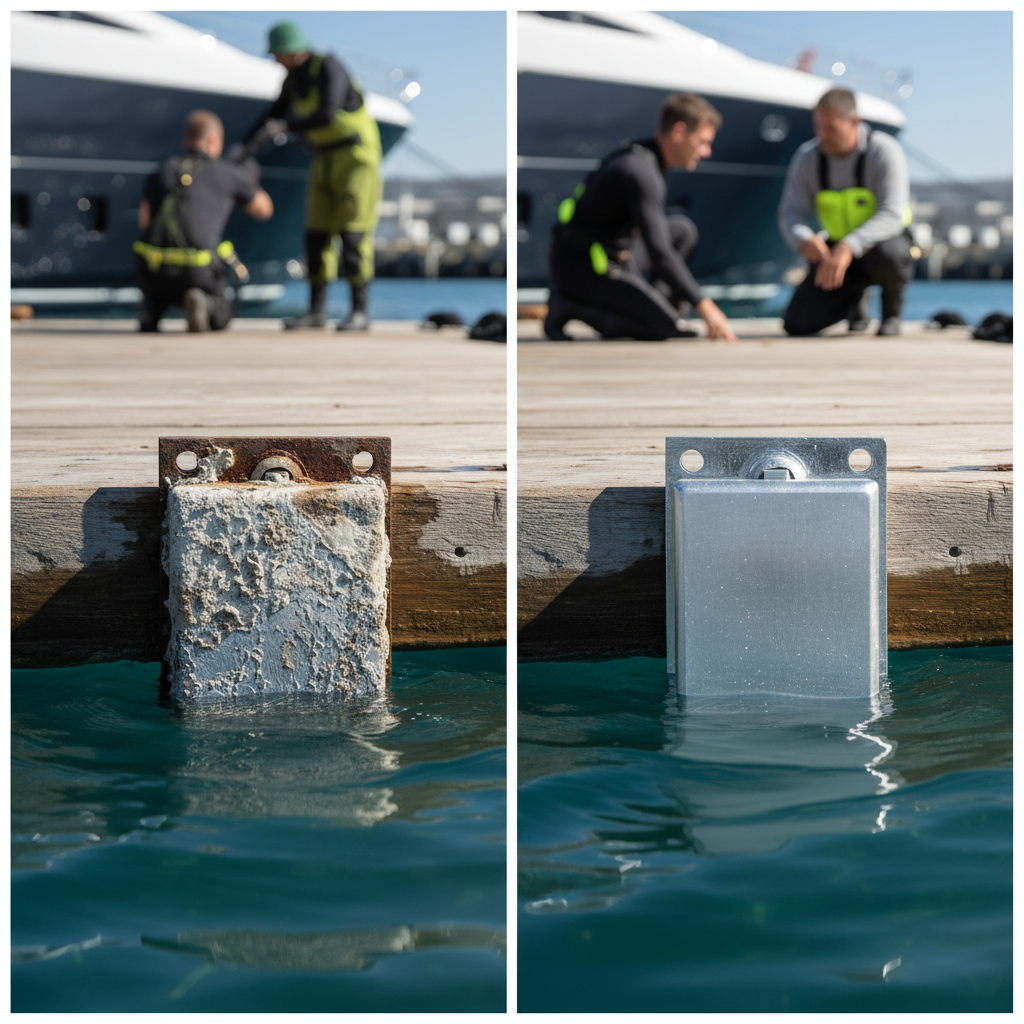
Corrosion is a silent killer of underwater metal components, and monitoring your sacrificial anode depletion is the only way to prevent permanent damage. In the electrically “noisy” environment of a busy marina like the Corinthian Yacht Club, stray current can eat through a propeller in weeks if your zincs are spent.
| Anode Material | Best Use Case | Depletion Rate Change |
|---|---|---|
| Zinc | Saltwater only | Standard |
| Aluminum | Salt/Brackish water | Slower, more effective |
| Magnesium | Freshwater only | Rapid in salt |
The real kicker? Anodes that are 50% depleted are effectively 100% unreliable. Once they lose mass, their ability to provide cathodic protection drops exponentially. During a Corinthian Yacht Club hull audit, we provide photo proof of every anode to ensure you aren’t guessing about your protection levels.
Step 3: Running Gear Integrity and Propeller Optimization
Your propeller is the most hard-working component of your boat, yet it is often the most neglected during pre-season boat maintenance. Even minor nicks or calcium deposits on the blades can cause cavitation, which vibrates through the drivetrain and causes long-term bearing wear.
But wait—propeller maintenance isn’t just about cleaning. It’s about inspecting the entire drivetrain. In our work with typical Bay Area mid-market recreational vessels, we frequently find fishing line wrapped behind the prop nut, which can migrate into the shaft seal and cause a slow, catastrophic leak.
- Shaft and Strut Inspection: Checking for play in cutlass bearings.
- Intake Grates: Ensuring cooling water flow is unobstructed for the engine and AC systems.
- Trim Tabs and Thrusters: Verifying mechanical movement and clearing growth from recessed areas.
We leverage our internal AI content engine, Ingest.blog, to track regional fouling trends, ensuring our audit framework stays ahead of seasonal shifts. This data-driven approach allows us to predict when your running gear will need the most attention based on Tiburon’s specific water salinity and temperature.
The Pre-Season ROI: Why Early Audits Win
Investing in an underwater inspection framework in March or April prevents the “Mid-July Crisis” when every dive team in the Bay Area is booked three weeks out. The ROI is clear: a boat that burns 15% less fuel and avoids a $5,000 prop shaft replacement pays for its annual diving service many times over.
What is a contrarian insight most owners hate to hear? Expensive “miracle” coatings aren’t a substitute for regular physical inspections. No matter how much you spend on fouling release coatings, the unique currents of the San Francisco Bay will eventually find a way to attach bio-growth to your running gear. Regularity beats technology every time.
Implementing Your Hull Health Log
Consistent record-keeping is what separates the casual owner from the true mariner. We provide before-and-after photo proof for every service, which serves as a digital health log for your vessel. This transparency is vital for maintaining resale value and ensuring your yacht is always ready for a Friday evening cruise past Angel Island.
To start your season right, we recommend a baseline audit. This involves a full video or photo survey of the hull, a percentage-based report on anode health, and a detailed check of all through-hulls. You can read more about our cleaning process to see how we maintain these standards.
Ready to secure your spot for the spring? Don’t wait until the first regatta of the season. Call us at 360 Hull Diving or visit our contact page to book your 3-step audit and ensure your boat is performing at its absolute peak.
Frequently Asked Questions
How often should I perform a Corinthian Yacht Club hull audit?
For boats kept in Tiburon, we recommend a professional audit every 3 to 4 weeks during the summer and every 6 to 8 weeks during the winter. This frequency ensures that biofouling remains in the “slime” stage, which is much easier and safer to remove without damaging your bottom paint.
Why is my fuel consumption increasing even though the hull looks clean?
Often, the visible waterline is clean, but the running gear or the “hidden” areas like the top of the rudder or inside sea chests are heavily fouled. A professional underwater inspection framework identifies these drag-heavy areas that are invisible from the dock, restoring your hydrodynamic efficiency.
Can I use zinc anodes in the brackish water near the Delta?
If you frequently travel between the salt water of the Corinthian Yacht Club and the brackish water of the Delta, you should consider switching to aluminum anodes. Zinc can develop a “calcite skin” in lower salinity, which prevents it from sacrificing properly, leaving your underwater metals unprotected.
What is the difference between an ROV inspection and a diver audit?
While ROVs are great for deep-water surveys, a diver-led pre-season boat maintenance audit is superior for recreational yachts because a diver can physically feel for bearing play, clear obstructions manually, and provide immediate tactile feedback on the condition of the hull coating.
Does a clean hull really make a difference for a casual cruiser?
Absolutely. Beyond fuel savings, a clean hull reduces engine strain and operating temperatures. It also ensures that your maneuverability in tight slips—like those at the Corinthian Yacht Club—remains predictable, as fouled propellers lose significant ‘bite’ and thrust in reverse.