
📋 Table of Contents
That unsettling vibration in your feet during a tight docking maneuver at Brisbane Marina isn’t just noise; it’s the sound of vapor bubbles imploding against your hardware with enough force to dent solid stainless steel. According to research published by the National Academies of Sciences, Engineering, and Medicine, cavitation can cause material erosion at rates significantly higher than standard corrosion, effectively ‘eating’ your propellers from the inside out.
Key Takeaways for Brisbane Cruisers
- Early Detection: Identifying bow thruster cavitation before pitting occurs saves roughly $5,000 in tunnel and gear replacement costs.
- Biofouling Connection: In the nutrient-rich waters of Brisbane, even minor barnacle growth on the tunnel intake triggers the turbulence that leads to cavitation.
- Visual Proof: High-resolution underwater photography is the only way to verify blade health without a costly haul-out at Rivergate or Westpoint.
1. Identify the Symptoms of Bow Thruster Cavitation
The first sign of trouble isn’t usually visible; it’s audible, manifesting as a sharp, crackling sound similar to gravel being tossed in a blender. What most people miss is that this noise represents the physical collapse of vacuum bubbles, a process that generates localized temperatures of thousands of degrees and immense pressure spikes.
For a typical Bay Area mid-to-upper income boat owner, these symptoms are often dismissed as ‘old age’ for the vessel. However, in the tidal surges of the Brisbane River, a compromised thruster means losing the precision required to stick a landing in a narrow slip during a cross-current. The real kicker? If you feel the vibration in the cabin sole, the erosion has likely already moved past the surface polishing stage into deep structural pitting.

Common symptoms include:
- Increased vibration that resonates through the forward V-berth.
- A noticeable drop in ‘pushing power’ when docking against the tide.
- A higher-pitched whine than usual during operation.
- Visible ‘cloudiness’ or aeration in the water jet exiting the tunnel.
If you’re noticing these signs, it’s time for a professional underwater thruster inspection to document the extent of the damage before the next summer cruising season.
2. Conduct an Underwater Thruster Inspection for Biofouling
In the high-growth waters of Brisbane Marina, biofouling isn’t just an aesthetic issue; it is the primary catalyst for premature thruster failure. When barnacles or tube worms colonize the leading edge of a thruster blade or the interior of the tunnel, they disrupt the laminar flow of water.
This turbulence creates low-pressure zones where water literally boils at ambient temperatures, forming the bubbles that cause bow thruster cavitation. We’ve seen cases where a single large oyster shell near the intake grate reduced thruster efficiency by nearly 30% while doubling the cavitation noise. Unlike open-water propellers, tunnel thrusters operate in a confined space where flow dynamics are incredibly sensitive to surface roughness.
| Growth Level | Impact on Performance | Cavitation Risk |
|---|---|---|
| Slime/Algae | 5-10% Loss | Low |
| Juvenile Barnacles | 15-25% Loss | Moderate |
| Heavy Calcareous Growth | 30%+ Loss | Critical |
Here’s the thing: many owners rely on ultrasonic antifouling systems, but these often struggle to protect the deep recesses of a thruster tunnel. A manual underwater thruster inspection remains the gold standard for ensuring the grate, blades, and zincs are clear of obstructions. Ready to see what’s actually happening down there? Schedule your photo-documented inspection today.
3. Analyze Photo Proof for Propeller Blade Pitting
The final step in our framework is the forensic analysis of high-definition imagery to distinguish between simple paint wear and actual metal erosion. Our dive teams at 360 Hull Diving specialize in capturing ‘macro’ shots of the blade tips—the area most susceptible to bow thruster cavitation damage.
What we look for in our high-res photo proof are ‘frosted’ areas on the metal. To the untrained eye, this looks like the paint has simply rubbed off, but under magnification, it reveals thousands of microscopic craters. This is the hallmark of cavitation. If left unchecked, these craters merge, leading to structural failure of the blade tip or ‘singing’ propellers that vibrate even at low RPMs.
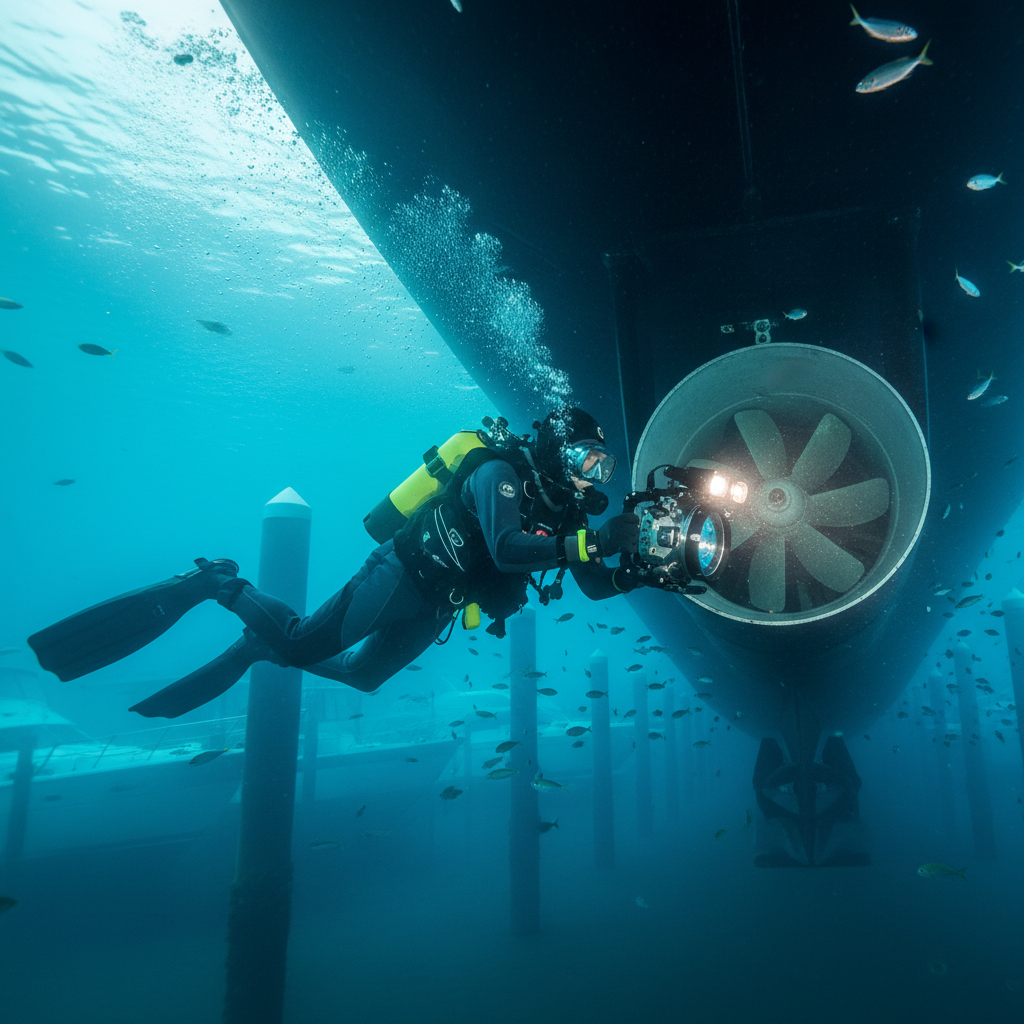
What most people miss is the ‘Silent Cruiser’ perspective: by addressing these surface imperfections early through smoothing and polishing, you can significantly reduce cabin noise. This is especially critical for Brisbane Marina cruisers who value a quiet, luxury experience while navigating the river. We use these photos to provide a ‘seaworthiness’ trail that many local insurance providers now look for during policy renewals.
But wait—don’t assume you need a new thruster. Often, a professional cleaning and a fresh set of high-quality zincs can stabilize the environment. You can learn more about our specific zinc and corrosion services to see how we protect your running gear from the aggressive galvanic activity found in Moreton Bay.
The Brisbane Summer Prep: Why Timing Matters
The October-December window is the most critical period for Brisbane Marina boat maintenance because rising water temperatures in Moreton Bay accelerate both biofouling and galvanic corrosion. As the water warms, the metabolic rate of barnacles increases, leading to rapid colonization of your thruster tunnel just when you need it most for summer holiday cruising.
In our work with recreational boat owners, we’ve found that a ‘preventative’ approach—cleaning the thrusters every 4-8 weeks—is significantly cheaper than the ‘reactive’ approach of waiting for a failure. The cost of a few dive sessions is a fraction of the price of a haul-out at a Brisbane shipyard, which can easily exceed $1,500 just for the lift and tressels.
The real kicker? Cavitating composite blades can actually shed micro-plastics into the pristine waters of the Bay. By maintaining smooth, clean blades, you aren’t just protecting your wallet; you’re practicing eco-conscious docking by reducing the mechanical breakdown of synthetic materials.
Maximizing Maneuverability in Tight Brisbane Slips
Navigating the Brisbane River’s currents requires a bow thruster that responds instantly and predictably. When bow thruster cavitation occurs, the thrust becomes ‘spongy’ because the propeller is spinning in a mix of water and air bubbles rather than solid water. This lag can be the difference between a perfect docking and a costly crunch against the finger pier.
Our internal AI content engine, Ingest.blog, helps us track maintenance trends across various boat makes, and the data is clear: vessels with documented monthly hull and thruster grooming hold higher resale value. Buyers at Brisbane marinas want to see a history of care, and our before-and-after photo reports provide exactly that transparency.
What most people miss: The condition of your thruster zincs is a direct indicator of your tunnel’s health. If your zincs are disappearing every 60 days, you likely have a stray current issue in your marina that will eventually exacerbate cavitation damage by weakening the metal surface of the blades.
Conclusion: Take Action Before the Next Tide
Don’t wait until you’re fighting a 15-knot crosswind at Brisbane Marina to find out your bow thruster is compromised. The 3-step cavitation audit—identifying noise, inspecting for growth, and analyzing photo proof—is a straightforward way to ensure your vessel remains maneuverable and quiet. This week, take five minutes to run your thruster at the dock. If it sounds like anything other than a smooth hum, it’s time to call in the professionals.
At 360 Hull Diving, we provide the transparency you deserve with every dive. Request your Brisbane Marina cavitation audit today and get the high-res proof you need to cruise with confidence.
Frequently Asked Questions
How can I tell the difference between normal thruster noise and cavitation?
Normal thruster noise is a consistent, mechanical hum or whirring. Cavitation sounds like sharp ‘pops’ or crackling, often compared to gravel hitting the hull. If the noise is accompanied by a rhythmic vibration that you can feel in the floorboards of the forward cabin, it is likely cavitation caused by growth or blade damage.
Does biofouling really cause cavitation in such a small tunnel?
Yes, absolutely. Because bow thruster tunnels are narrow, any growth on the intake or the blades themselves creates massive turbulence. This turbulence drops the local water pressure, causing the water to vaporize into bubbles that implode against the blades. In Brisbane’s high-growth environment, even a thin layer of barnacles can trigger this process.
Can cavitation damage be repaired without pulling the boat out of the water?
Minor surface ‘frosting’ or roughness can often be smoothed out by a skilled diver using specialized underwater polishing tools. However, deep pitting or structural cracks in the blades usually require the boat to be hauled out at a facility like Rivergate for component replacement. Early detection via our 3-step audit is designed to catch damage while it is still in the ‘polishable’ stage.
How often should I have an underwater thruster inspection in Brisbane Marina?
Given the aggressive growth patterns in the Brisbane River and Moreton Bay, we recommend a visual underwater thruster inspection every 2 to 3 months. During the peak summer window (October to March), monthly checks are ideal to ensure the intake grates aren’t blocked by debris or heavy barnacle clusters that lead to overheating and cavitation.