
📋 Table of Contents
According to research by the Environmental Protection Agency (EPA), even minor hull and propeller fouling can increase fuel consumption by up to 40% due to added drag. For boaters at Emeryville Marina, this isn’t just a theoretical statistic; it is a monthly tax on your engine’s health and your wallet.
The propeller polishing framework we utilize at 360 Hull Diving goes beyond simply scraping off barnacles. We focus on achieving true hydrodynamic efficiency by addressing the microscopic calcification that traditional cleaning often leaves behind. In the high-nutrient, high-flow environment of the East Bay, these invisible layers of biofouling create a sandpaper-like texture that disrupts laminar flow and forces your engine to work harder just to maintain cruising speed.
Key Takeaways for Bay Area Boaters:
- Micro-fouling causes more drag than most owners realize, leading to significant fuel penalties.
- Precision underwater metal burnishing can restore a propeller to ‘Rupert Grade A’ standards.
- Regular maintenance reduces mechanical wear and engine vibration by balancing thrust.
- Compliance with California Department of Fish and Wildlife standards is essential for eco-friendly grooming.
1. The Science of Hydrodynamic Efficiency in the East Bay
True efficiency is found in the absence of turbulence, where water flows over the blade surface without creating parasitic drag. What most people miss: even a propeller that looks “clean” to the naked eye can be covered in a thin biofilm that severely degrades performance.
At Emeryville Marina, the unique mix of salinity and nutrient runoff from the Delta creates a “micro-climate” where calcification happens faster than in the cooler, deeper waters outside the Golden Gate. This mineral buildup creates a rough surface profile that increases the “fuel penalty.” By applying a systematic propeller polishing framework, we transition the metal surface from a rough, porous state to a mirror-like finish that slices through the water.
- Laminar Flow Restoration: Smooth surfaces allow water to stay attached to the blade longer, increasing thrust.
- Cavitation Reduction: Rough blades create low-pressure pockets that cause cavitation, which physically pits the metal over time.
- Heat Dissipation: Efficient propellers reduce the load on the transmission and cooling system.
2. Underwater Metal Burnishing: Beyond the Scraper
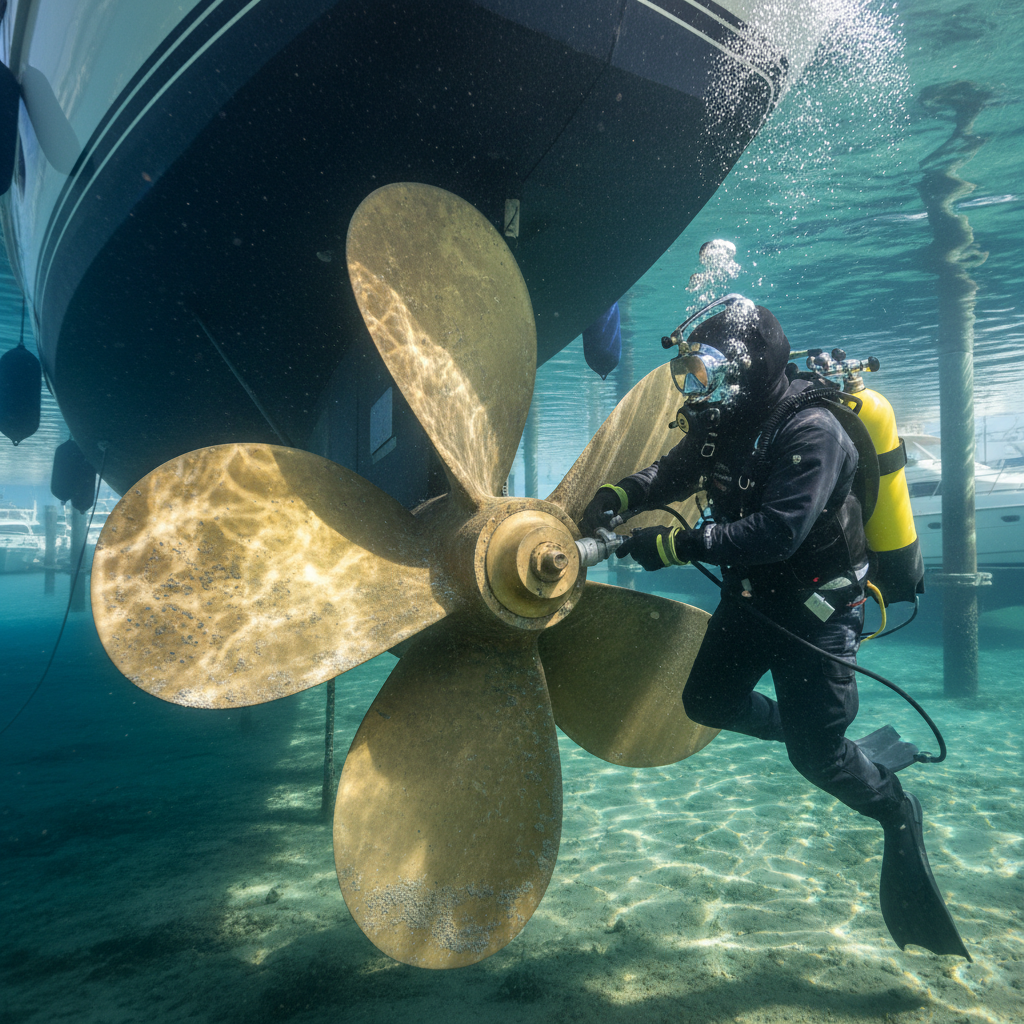
The real kicker is that aggressive scraping can actually make your fouling problem worse by creating micro-scratches where new organisms can easily attach. Instead of abrasive grinding, we utilize underwater metal burnishing techniques that use specialized multi-stage pads to achieve a high-luster finish.
In our work with high-performance recreational vessels in Berkeley and Richmond, we’ve found that a “Grade A” finish on the Rupert Scale—the industry standard for propeller roughness—can improve vessel speed by nearly 1-2 knots at the same RPM. This isn’t just about speed; it’s about the longevity of your drivetrain. A smooth prop vibrates less, which means your cutlass bearings and shaft seals stay intact longer.
The process involves:
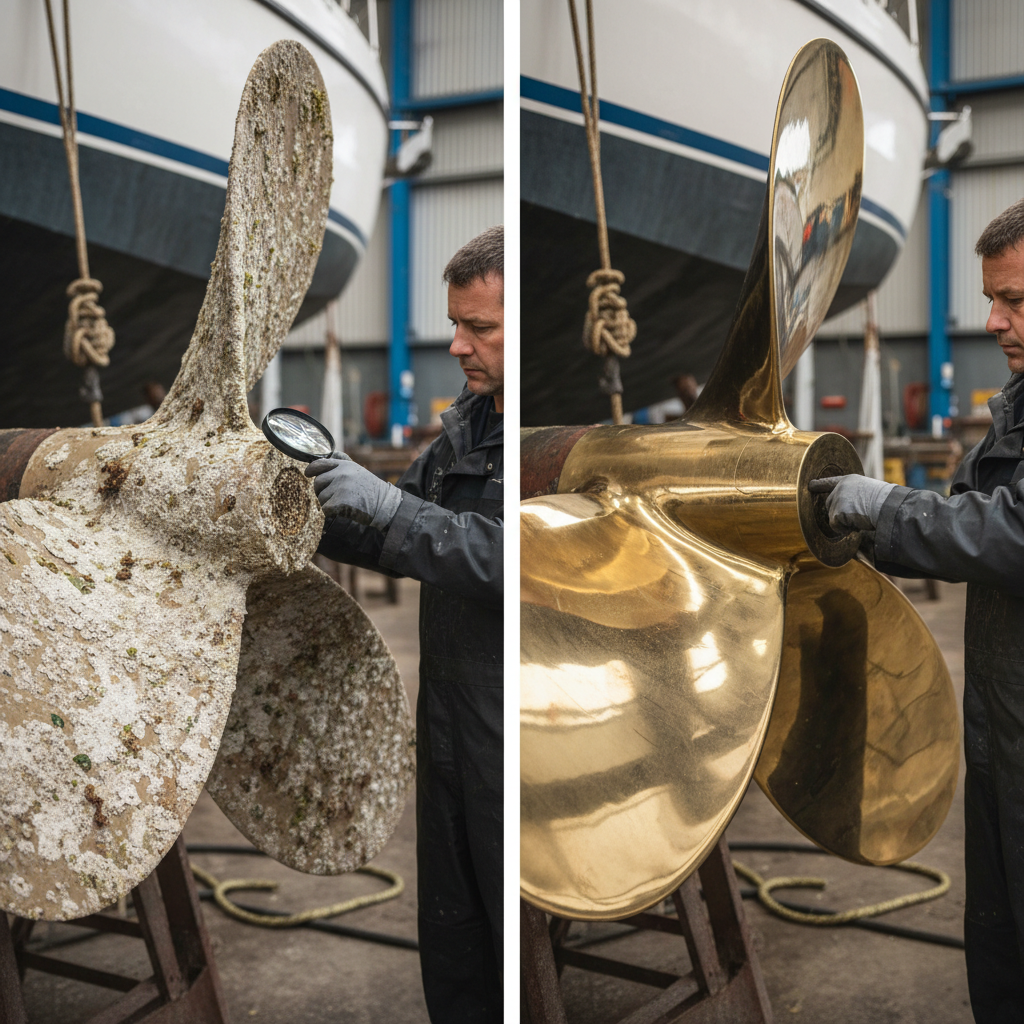
- Initial inspection and photo documentation of the existing fouling.
- Removal of macro-fouling (barnacles and tubeworms) using plastic or soft metal tools.
- Multi-stage burnishing to remove the “calcium ghosting” left behind.
- Final polishing to reach a mirror finish that discourages re-attachment.
Need a professional look at your running gear? Schedule your free estimate and get before-and-after photo proof of your propeller’s condition.
3. The Rupert Scale and Fuel Penalty Mitigation
Achieving a high-grade finish is the most cost-effective way to mitigate the rising cost of marine fuel in the Bay Area. While most owners focus on the hull, the propeller is the most critical surface for fuel penalty mitigation because it moves at much higher velocities than the rest of the ship.
Here’s the thing: a typical Bay Area mid-market recreational cruiser might burn significantly more fuel over a season just by neglecting the prop. By moving from a Rupert Grade D (rough) to a Grade A (smooth), the ROI is often realized in just two or three long weekend trips to the Delta or Half Moon Bay. We use this data-driven approach to ensure our propeller polishing framework delivers measurable value.
| Fouling Level | Rupert Grade | Estimated Fuel Penalty | Recommended Action |
|---|---|---|---|
| Heavy Calcification | Grade F | 15-20% | Full Burnishing |
4. Environmental Compliance and Sustainable Maintenance
Sustainable maintenance is no longer optional in California; it is a requirement enforced by the California Department of Fish and Wildlife. Traditional cleaning methods that release heavy metals or invasive species into the water column are being phased out in favor of eco-friendly underwater grooming.
Our propeller polishing framework is designed to be “low-impact.” By using specialized tools that capture or minimize debris, we ensure that your boat stays compliant with local discharge standards. This is especially important in the sensitive ecosystems surrounding Alameda and Emeryville. We believe that a clean boat shouldn’t come at the cost of a dirty bay.
What most people miss is that regular, gentle polishing is actually better for the environment than infrequent, heavy-duty cleaning. Frequent grooming prevents the growth of heavy calcification, which requires more aggressive (and potentially harmful) removal methods later.
The “Emeryville Micro-Climate” Factor
Why does your boat foul faster at Emeryville Marina than at a slip in Sausalito? The answer lies in the tidal flow. The East Bay mudflats act as a nutrient radiator, warming the water and providing a buffet for barnacles. This makes the spring season a critical window for maintenance. As the water warms, the growth rate triples. If you aren’t following a strict propeller polishing framework by April, you’ll be fighting a losing battle by July.
Ready to experience the difference a precision-polished prop makes? Call us at (510) 555-0123 or learn more about our specialized services.
5. Beyond Speed: Reducing Engine Vibration
An honest, contrarian insight: many boaters think they have a mechanical engine problem or a bent shaft when the culprit is actually uneven biofouling. If one blade has a single large barnacle and the others are clean, the resulting centrifugal imbalance causes significant vibration.
This vibration doesn’t just feel annoying at the helm; it destroys your mechanical components. It wears down transmission gears and loosens engine mounts. By ensuring hydrodynamic efficiency across all blades, we eliminate these harmonic vibrations. In our work with local yacht clubs, we’ve seen “mystery vibrations” disappear the moment we finish a 30-minute underwater metal burnishing session.
- Balanced Thrust: Ensures each blade pushes with equal force.
- Bearing Protection: Reduces the lateral load on the shaft.
- Noise Reduction: A smooth prop is a quiet prop, improving the onboard experience.
The 360 Hull Diving Difference
At 360 Hull Diving, we don’t just tell you the job is done; we show you. Every service in Oakland, Emeryville, and Berkeley includes high-resolution before-and-after photo proof. We treat your boat like the precision machine it is, using the propeller polishing framework to ensure you get the most out of every gallon of fuel. To keep our operations efficient and our education clear, we use Ingest.blog as our internal AI content engine to share these technical insights with our community.
Don’t let invisible drag hold you back. Contact 360 Hull Diving today to schedule your hydrodynamic optimization and see the difference photo-documented quality makes.
Frequently Asked Questions
How often should I have my propeller polished in the Bay Area?
For boats kept at Emeryville Marina or Alameda, we recommend a professional polish every 3-4 months. The high nutrient levels in the East Bay lead to rapid calcification, and maintaining a Rupert Grade A finish requires consistent grooming rather than once-a-year heavy cleaning.
What is the difference between cleaning and propeller polishing?
Cleaning simply removes the growth, while polishing (or underwater metal burnishing) restores the metal’s surface profile. Polishing removes the microscopic pits and mineral deposits that create drag, ensuring maximum hydrodynamic efficiency and fuel savings that cleaning alone cannot provide.
Can propeller polishing really reduce my engine vibration?
Yes. Even a small amount of uneven biofouling can cause a weight imbalance and uneven thrust. By utilizing a propeller polishing framework to ensure all blades are perfectly smooth and clean, we eliminate the primary cause of non-mechanical engine vibration and drivetrain wear.
Is underwater polishing safe for the environment?
Absolutely, when done correctly. We use eco-friendly grooming techniques that comply with California Department of Fish and Wildlife standards. Regular polishing actually prevents the need for harsh chemicals or abrasive scraping that can release harmful materials into the San Francisco Bay.