
📋 Table of Contents
A 45-foot cruiser recently limped into a repair yard after a San Leandro Marina bow thruster failed during a 20-knot crosswind docking maneuver, resulting in a $16,500 repair bill. Most owners think the ‘soft’ green grass waving in the current is harmless, but that slime is actually a cloaking device for calcified destruction.
The Economic Forensics of a $16,500 Thruster Motor Burnout
What most people miss is that underwater mechanical failure isn’t usually a ‘snap’—it’s a slow strangulation that ends in a high-voltage surge. When bio-fouling builds up in the narrow tolerances of a thruster tunnel, the physics of your boat changes instantly.
- The Load Factor: Just 3 inches of ‘soft’ growth increases the torque requirement on your motor by 400%.
- The Heat Spike: As the motor struggles to spin the fouled prop, internal temperatures exceed 300°F in seconds.
- The Mechanical Snap: If the shear pin doesn’t go first, the internal gears or the motor windings will.
The real kicker? That $16,500 bill included a $4,000 emergency haul-out, $8,500 for a new 24V motor assembly, and $4,000 in specialized labor and fiberglass repair. Compare that to a $300 dive service, and the ROI on hull husbandry becomes painfully obvious.
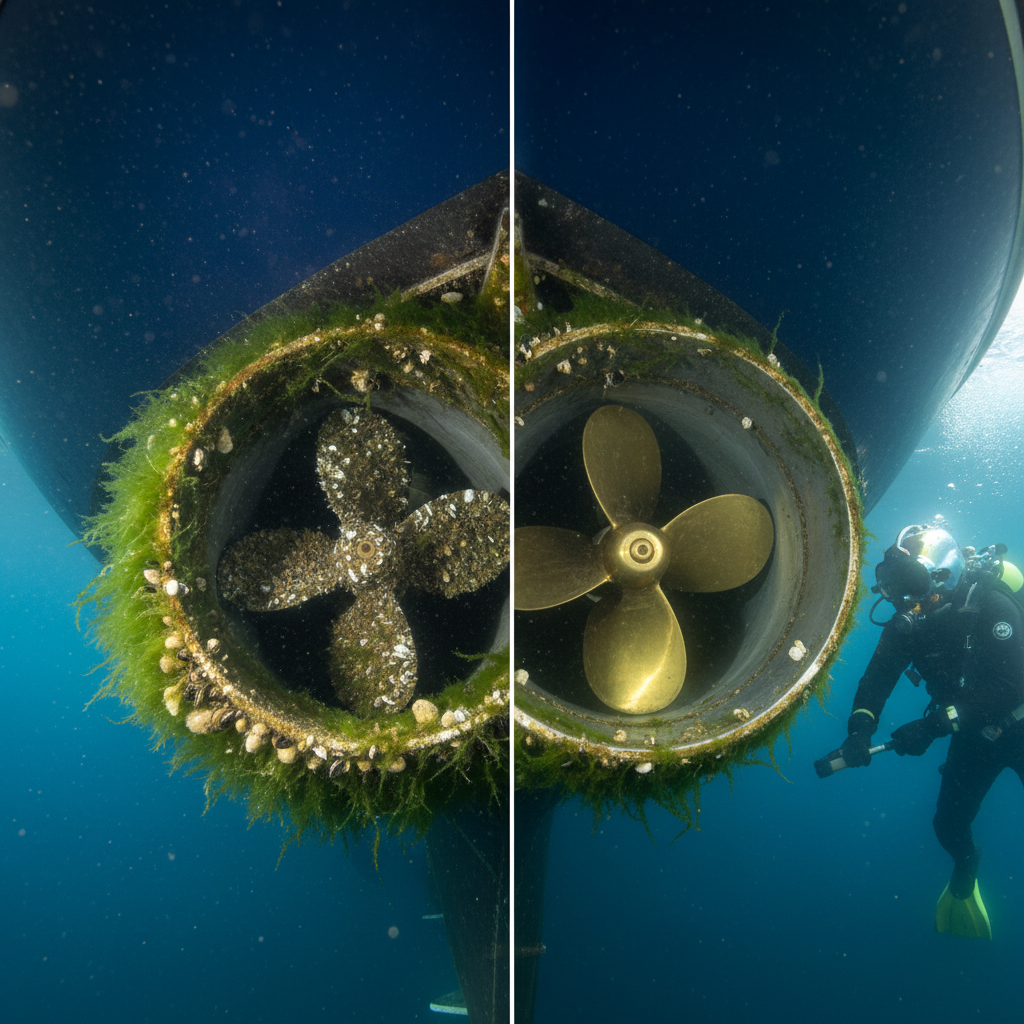
Why San Leandro Marina Accelerates Underwater Mechanical Failure
San Leandro is a unique ecological ‘hot zone’ where shallow, nutrient-rich waters meet high salinity, creating a steroid-like effect on barnacle growth. The water temperature in the East Bay lagoons often sits 3-5 degrees higher than the central Bay, which acts as an incubator for rapid bio-fouling remediation needs.
- Salinity Spikes: Higher salt content accelerates the calcification of barnacle bases against stainless steel shafts.
- Stagnant Flow: Marinas with less tidal flushing allow ‘soft’ growth to transition into hard shell growth in as little as 14 days.
- Electrolysis: Poorly maintained docks in older marinas can increase stray current, leading to rapid zinc depletion.
One of our clients, a tech executive with a beautiful Sabre 48 at the San Leandro Marina, thought skipping his winter cleanings was a savvy cost-saving move. By March, his thruster tunnel was so choked with tube worms that the motor drew double its rated amperage, melting the solenoid and nearly starting a fire in the forward bilge.
The ‘Soft Growth’ Trap: Why Slime is a Warning, Not an Aesthetic Issue
The contrarian truth is that ‘soft’ growth is often more dangerous than barnacles because it causes thruster cavitation. This creates air bubbles that implode against the propeller blades with enough force to pit solid metal. According to the EPA’s research on bio-fouling, even a microscopic biofilm can increase drag by 10%, but in a confined thruster tunnel, that drag is exponential.
The Canary in the Coal Mine: Why Your Thruster Fails First
Your bow thruster is the most sensitive piece of equipment on your hull because it operates in a high-pressure, low-clearance environment. If you see grass on your waterline, your thruster is already in critical condition.
| Growth Level | Mechanical Impact | Estimated Repair Cost |
|---|---|---|
| Light Slime | 5% Efficiency Loss | $0 (Routine Cleaning) | Heavy Grass | 40% Load Increase | $400 (Heavy Cleaning) | Barnacles/Shells | Seized Propeller | $2,500 (Motor Repair) | Total Obstruction | Motor Burnout | $12,000 – $18,000 (Replacement) |
Need help protecting your investment? Schedule your free hull inspection estimate before the next windstorm hits. We provide before-and-after photo proof so you aren’t just taking a diver’s word for it.
Insurance Claim Denials: The Secret Cost of Deferred Maintenance
Here is something your broker won’t tell you: most insurance policies explicitly exclude ‘wear and tear’ or ‘lack of maintenance’ from coverage. When a San Leandro Marina bow thruster burns out due to growth, adjusters often categorize this as a preventable failure.
- The Evidence: Adjusters look for ‘witness marks’ of barnacles inside the motor housing.
- The Denial: If growth is the root cause, you are paying that $16,500 out of pocket.
- The Solution: Regular underwater gear failure prevention through documented dive logs.
We recently saw a claim for a Grand Banks in Alameda denied because the owner couldn’t produce a single receipt for hull cleaning in 12 months. The insurance company argued that the thruster motor burnout was inevitable and therefore not a ‘sudden and accidental’ loss.
Asset Protection vs. ‘Just a Cleaning’
Stop thinking about hull cleaning as a chore and start thinking about it as asset protection. A $1M yacht is a complex machine that happens to live in a corrosive, biological soup. At 360 Hull Diving, we treat every dive as a mechanical inspection.
What most divers miss: they scrub the outside but ignore the seals. We check the integrity of your thruster seals and the state of your sacrificial anodes every single time. It’s the difference between a ‘clean boat’ and a ‘reliable boat.’
The Critical Timeline of Bio-Fouling Damage
In the San Francisco Bay, the transition from ‘slime’ to ‘structural damage’ happens faster than most owners realize. As noted by BoatUS maintenance guides, deferred maintenance is the leading cause of value depreciation in recreational vessels.
- Week 1-2: Biofilm forms, attracting larger organisms.
- Week 4: Small barnacles begin to ‘glue’ themselves to your running gear.
- Week 8: Growth enters the thruster gear leg, threatening the oil seals.
Stop the Bleeding: Why You Need Photo Proof
The industry is full of ‘splash and dash’ divers who do half the job because nobody can see their work. This is why 360 Hull Diving provides high-resolution photo proof of every San Leandro Marina bow thruster we service. If we don’t show you the clean prop, we haven’t done our job.
Ready to stop gambling with your mechanical systems? Contact us today for a comprehensive underwater health report. Don’t wait for a $16,500 wake-up call when the wind is blowing you toward the rocks.
Key Takeaways for Bay Area Boat Owners
- Soft growth is a lie: Slime hiding in the thruster tunnel is the primary cause of motor burnout.
- San Leandro is high-risk: Local water conditions accelerate calcification faster than the Central Bay.
- Maintenance is insurance: Documented cleanings prevent insurance claim denials and five-figure repair bills.
Frequently Asked Questions
How can I tell if my bow thruster is starting to fail?
The first sign is usually a change in the pitch of the motor. A high-pitched whine or a sluggish response indicates that the motor is drawing too much power due to growth. If you notice a delay in thrust or increased vibration, you likely have significant bio-fouling in the tunnel that requires immediate professional remediation.
Does insurance cover a thruster motor burnout?
In most cases, no. Insurance companies view marine growth as a maintenance issue. If a post-failure inspection reveals that the motor burned out because it was choked with barnacles or grass, they will likely deny the claim under the ‘wear and tear’ exclusion. Maintaining a regular dive schedule is your best defense against these costs.
How often should I have my hull cleaned in San Leandro?
Given the high nutrient levels and warmer water in San Leandro Marina, we recommend a 3-week cleaning cycle during the peak summer months and a 4-week cycle in the winter. This prevents ‘soft’ growth from transitioning into hard calcification that can damage thruster seals and gear legs.
Can I clean the bow thruster myself with a brush?
While you can reach the outer edges, you cannot effectively clean the propeller blades, the gear leg, or the internal tunnel walls without scuba gear. Attempting to clean it from the surface often pushes debris deeper into the tunnel, which can jam the propeller and cause the very motor burnout you are trying to avoid.
The $16,500 repair bill we discussed wasn’t an act of God—it was a choice. Every month you skip a cleaning, you are essentially betting $16,000 that your thruster won’t fail when you need it most. In the Bay Area, that is a bet you will eventually lose. Protect your boat, protect your wallet, and get the photo proof you deserve.