
📋 Table of Contents
Key Takeaways:
- Pittsburg Marina’s brackish water creates a high-conductivity environment that accelerates stray current corrosion.
- Underwater cable faults from aging dock infrastructure or neighboring vessels can dissolve a stainless steel shaft in weeks.
- Documented monthly dive inspections with photo proof are the only reliable way to catch boat shaft pitting before it leads to failure.
- Investing in a galvanic isolator and high-quality sacrificial anodes is mandatory for Delta-based yachts.
Managing a high-value asset in the California Delta requires more than just routine oil changes; it requires a sophisticated understanding of the electrical environment beneath the waterline. For boaters docked at the eastern edge of the Suisun Bay, Pittsburg Marina stray current represents a silent, invisible threat that can cause tens of thousands of dollars in mechanical damage. Unlike standard electrolysis, which progresses slowly, stray current caused by underwater cable faults acts with aggressive speed, literally stripping metal atoms from your running gear.
As of 2024, marine insurance providers are increasingly scrutinizing corrosion claims, often denying coverage if the owner cannot provide documented proof of cathodic protection maintenance. At 360 Hull Diving, we serve as your technical risk-mitigation partner, providing the forensic underwater data needed to protect your investment. Whether you are moored in Pittsburg, Antioch, or Martinez, understanding the nexus of brackish water and electrical leakage is critical for operational longevity.
The Technical Reality of Pittsburg Marina Stray Current
To understand why Pittsburg Marina stray current is particularly lethal, one must look at the salinity gradient of the Delta. Pittsburg sits at a geographical crossroads where the fresh water of the Sacramento and San Joaquin rivers meets the saltier tides of the San Francisco Bay. This brackish mixture creates a highly conductive electrolyte that facilitates the flow of stray electrical current far more efficiently than pure fresh water.
When underwater cable faults occur—whether in the marina’s shore power grid or a neighbor’s faulty water heater—the electricity seeks the path of least resistance to ground. Frequently, that path is through your boat’s bonded underwater hardware. This process, known as stray current corrosion, leads to rapid boat shaft pitting and propeller degradation that defies standard maintenance schedules.
- High Conductivity: Brackish water increases the rate of metal loss per ampere of current.
- Infrastructure Age: Older municipal docks may have compromised shielding on submerged power lines.
- Neighboring Interference: A single boat with a DC ground fault can affect every vessel on the same dock finger.
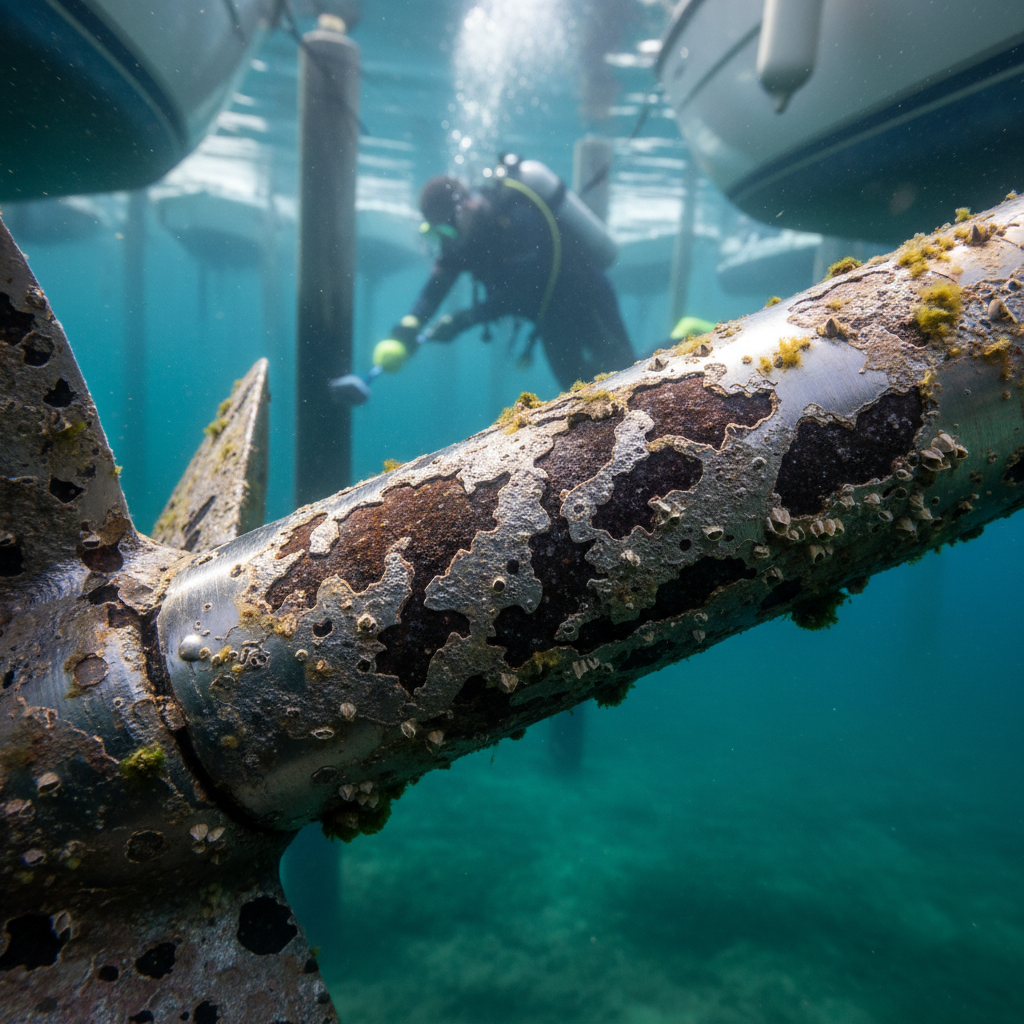
Why Conventional Anodes Fail in the Delta
Many boat owners rely on standard zinc anodes, but in the low-salinity environment of Pittsburg, zinc can develop a ‘calcareous coating’ that effectively insulates the anode, rendering it useless. Consequently, the stray current bypasses the protection and attacks the more noble metals, such as your 316 stainless steel shaft or bronze propellers.
According to the Association for Materials Protection and Performance (AMPP), the electrochemical potential of your vessel must be precisely managed to prevent these localized ‘hot zones.’ We recommend aluminum or specialized magnesium anodes for boats frequently transitioning between the San Pablo Bay and the Delta to ensure constant protection.
Identifying Underwater Cable Faults and Shore Power Leakage
The most dangerous aspect of underwater cable faults is their invisibility to the naked eye. While you may notice a tripped breaker or a slight tingle when touching a metal stanchion, the real damage is happening ten feet below the surface. Our dive teams frequently encounter ‘hot’ docks where the electrical field is strong enough to be detected by specialized underwater testing equipment.
Strategic monitoring is the only way to avoid catastrophic failure. Sophisticated owners should look for the following red flags that indicate a shore power leakage issue is affecting their slip:
- Rapid Anode Depletion: If your 6-month anodes are disappearing in 4 weeks, you have a stray current issue.
- Pink Propellers: A pinkish hue on bronze components indicates that the tin and zinc have been leached out, leaving only porous copper.
- Blistering Paint: Specifically around thru-hulls and the waterline, which suggests high electrical activity.
- Mysterious Battery Drain: Constant DC leakage often points to a ground fault within the marina’s wiring.
Need a professional assessment of your boat’s underwater health? Schedule a forensic hull inspection today to catch these issues before they escalate.
The Forensic Approach to Boat Shaft Pitting
When we perform a hull cleaning in Pittsburg or nearby Antioch, we aren’t just scrubbing slime; we are performing a forensic audit of your running gear. Boat shaft pitting often starts as microscopic craters that, if left unchecked, create stress concentrations that lead to a snapped shaft while underway. This is a nightmare scenario for any captain navigating the heavy currents of the Carquinez Strait.
Our divers are trained to identify the specific patterns of stray current damage. Unlike the uniform wear of natural galvanic corrosion, stray current creates jagged, deep pits and ‘wormholes’ in the metal. This localized attack is often the result of a neighbor’s faulty wiring or a compromised submersible pump in the marina’s basin.
| Feature | Galvanic Corrosion | Stray Current Corrosion |
|---|---|---|
| Cause | Dissimilar metals in contact | External electrical leak (fault) | Speed | Slow (Months/Years) | Extreme (Days/Weeks) | Visual Sign | Uniform surface thinning | Deep, localized pitting | Solution | Proper Sacrificial Anodes | Fault Isolation & Diver Monitoring |
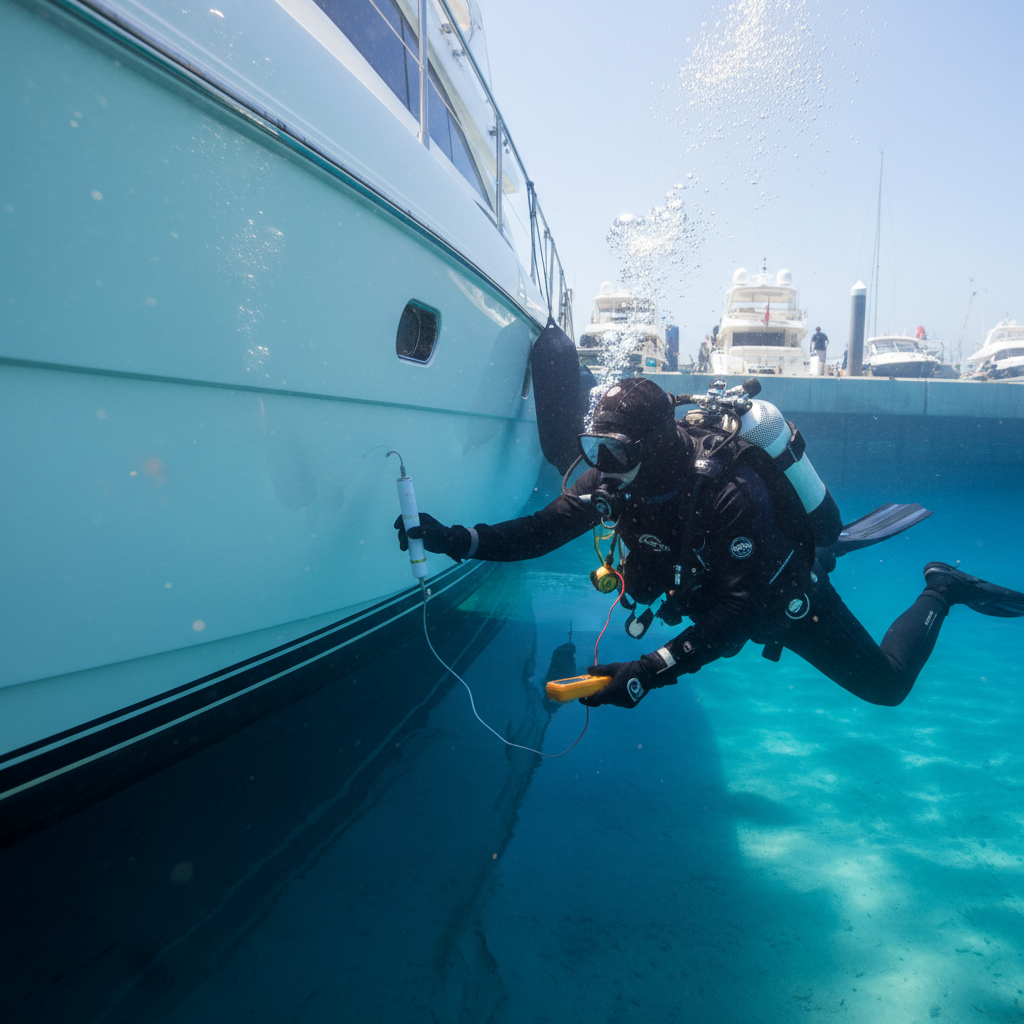
The ROI of Prevention: $200 vs. $15,000
For the C-suite executive or business leader, the ROI calculation on marine maintenance is clear. A monthly dive service including a silver-chloride reference electrode test costs a fraction of the price of a hauled-out repair. Replacing a 2-inch stainless steel shaft, including labor, haul-out fees, and lost time, can easily exceed $15,000 for a 45-foot cruiser.
Furthermore, the U.S. Environmental Protection Agency (EPA) emphasizes that maintaining clean, efficient running gear reduces fuel consumption and minimizes the carbon footprint of recreational boating. By keeping your shafts smooth and your propellers pitched correctly, you are optimizing both your balance sheet and your environmental impact.
How Modern Technology Mitigates Delta Corrosion
The evolution of marine technology has provided new tools to combat Pittsburg Marina stray current. We are seeing a shift toward the installation of isolation transformers, which physically decouple your boat’s electrical system from the shore power grid. While more expensive than a standard galvanic isolator, they provide the ultimate firewall against underwater cable faults originating from the dock.
Additionally, the rise of Lithium-ion battery conversions in the Bay Area has introduced new complexities. Improperly installed high-output alternators or BMS systems can create internal DC leaks that manifest as external corrosion. This is why we provide high-resolution before-and-after photo proof with every service, allowing you to track the health of your running gear in real-time through our client portal.
- Silver-Chloride Testing: We measure the millivolt potential of your hull to ensure you are in the ‘protected’ zone.
- Digital Documentation: Every dive includes a report that can be used for insurance compliance and resale value.
- Local Expertise: We understand the specific ‘hot spots’ at marinas from Benicia to Rio Vista.
Don’t let invisible electrical faults destroy your vessel’s value. Explore our comprehensive hull maintenance plans designed specifically for the unique challenges of the California Delta.
Shore Power Safety and the ‘Sniff Test’
While our divers handle the underwater aspects, boat owners should be proactive on the dock. Pittsburg Marina stray current can sometimes be identified through simple observation. Check your shore power cables for signs of overheating, melting, or corrosion on the pins. A warm plug is a sign of high resistance and a potential precursor to a ground fault.
Transitioning to a regular inspection schedule ensures that you are never caught off guard by municipal infrastructure failures. As the city of Pittsburg continues to modernize its waterfront, staying ahead of these changes is vital for any serious mariner. We recommend a ‘shore power sniff test’—checking for the smell of ozone or burning plastic near your 30/50 amp inlets—every time you return to your slip.
Conclusion: Partnering for Protection
The waters of the Pittsburg Marina are beautiful but chemically and electrically complex. Protecting your boat from underwater cable faults and the resulting boat shaft pitting requires a proactive, data-driven approach. By combining high-quality cathodic protection with monthly professional dive inspections, you can navigate the Delta with total confidence.
At 360 Hull Diving, we pride ourselves on being the Bay Area’s most trusted, insured dive team. We don’t just clean hulls; we provide the peace of mind that comes with expert technical oversight. From the Richmond Marina to the docks of Pittsburg, we are committed to keeping your running gear pristine and your adventures uninterrupted.
Ready to secure your boat’s future? Contact 360 Hull Diving today for a professional consultation and custom maintenance schedule. Let us be your eyes beneath the surface.
Frequently Asked Questions
How do I know if my boat is suffering from Pittsburg Marina stray current?
The most immediate signs are sacrificial anodes that disappear much faster than usual (within weeks) and the appearance of bright, jagged pitting on your propeller or shaft. If you notice a ‘tingle’ in the water or when touching metal parts while plugged into shore power, you likely have a dangerous stray current leak that requires immediate professional attention.
Can underwater cable faults at the marina affect my boat even if my wiring is perfect?
Yes. Electricity in the water follows the path of least resistance to ground. If a dock transformer or a neighboring boat has a fault, your boat’s bonded underwater hardware can act as a return path. This is why a galvanic isolator or isolation transformer is essential for boats docked in high-conductivity brackish water like Pittsburg.
What is the difference between normal electrolysis and boat shaft pitting?
Normal electrolysis (galvanic corrosion) is a slow process caused by the natural voltage difference between different metals. Stray current causes aggressive ‘pitting,’ which looks like small craters or drill holes in the metal. Pitting is far more dangerous as it compromises the structural integrity of the shaft much faster than surface corrosion.
How often should I have a diver inspect my boat in the Delta?
Due to the high bio-fouling rates and the risk of stray current in the Delta, we recommend monthly inspections. This frequency allows our divers to catch the early stages of boat shaft pitting and ensure your anodes are still functional, preventing small electrical issues from turning into expensive mechanical failures.